Construction 3.3.10 (Cellular chain complex). Let \(X\) be an anima with a CW-structure. Using Lemma 3.3.9, portions of the long exact sequences for the pairs \((X^{n+1}, X^n)\), \((X^n, X^{n-1})\), and \((X^{n-1}, X^{n-2})\) fit into the following commutative diagram:
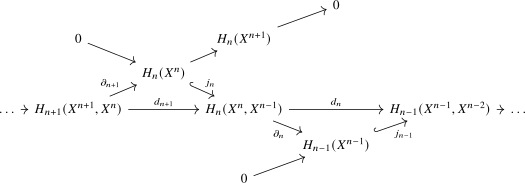
Here the maps \(j_n\) and \(\partial _n\) come from the long exact sequence of the pair \((X^n, X^{n-1})\). Since \(H_n(X^{n-1}) = 0\) by Lemma 3.3.9(b), the map \(j_n\) is injective for every \(n\). We define the cellular boundary maps as the compositions \[ d_n \;:=\; j_{n-1} \circ \partial _n \colon H_n(X^n, X^{n-1}) \to H_{n-1}(X^{n-1}, X^{n-2}). \] Since \(\partial _n \circ j_n = 0\) (as these are consecutive maps in an exact sequence), we have \(d_n \circ d_{n+1} = 0\). Thus the groups \[ C_n^{\mathrm {CW}}(X) := H_n(X^n, X^{n-1}) \] with differentials \(d_n\) form a chain complex, called the cellular chain complex of \(X\).
By Lemma 3.3.9(a), the cellular chain group \(C_n^{\mathrm {CW}}(X)\) is a free abelian group with one generator for each \(n\)-cell of \(X\). We write \(e^n_{\alpha } \in C_n^{\mathrm {CW}}(X)\) for the generator corresponding to the \(n\)-cell indexed by \(\alpha \in I_n\).
Generated from the authoritative LaTeX source.