Theorem 4.2.2. For a pointed \(\infty \)-category \(C\), the following conditions are equivalent:
- (1)
-
The \(\infty \)-category \(C\) admits pushouts and pullbacks, and a commutative square

in \(C\) is a pushout square if and only if it is a pullback square.
- (2)
-
The \(\infty \)-category \(C\) is stable;
- (3)
-
The \(\infty \)-category \(C\) admits fibers and the loop functor \(\Omega \colon C \to C\) is an equivalence;
- (4)
-
The \(\infty \)-category \(C\) admits cofibers and the suspension functor \(\Sigma \colon C \to C\) is an equivalence.
Proof. It is clear that (1) implies (2) by taking \(W = 0\). If we assume (2), then the fiber sequence

is by assumption also a pushout square and thus the counit map \(\Sigma \Omega X \to X\) is an equivalence. Similarly the unit map \(X \to \Omega \Sigma X\) is an equivalence. It follows that \(\Sigma \) and \(\Omega \) are inverse equivalences, so that (3) and (4) hold.
We now show that (3) implies (1); applying the argument to \(C\catop \) will then show that also (4) implies (1), finishing the argument. We will first show that \(C\) admits pushouts and that pushout squares agree with pullback squares. To this end, consider the full subcategory \[ P \subseteq \Fun ([1] \times [1], C) \] spanned by the pullback squares. We then have the following claim:
Claim: The restriction functor \(P \to \Fun (\;\pushout \;,C)\) is an equivalence.
Proof of claim: To construct an inverse, consider a diagram \(z \leftarrow x \rightarrow y\) in \(C\), and consider the following pullback diagram (ignoring the dashed morphisms):
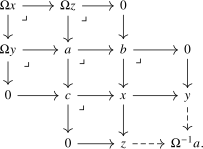
Note that each of the pullbacks that appear here may be obtained as a fiber, hence is assumed to exist in \(C\). More explicitly, starting from the span \(z \leftarrow x \to y\), set \[ b := \fib (x \to y), \qquad c := \fib (x \to z). \] Then define \(a\) as the fiber of the composite \(b \to x \to z\). The nullhomotopy of \(a \to b \to x \to z\) induces a map \(a \to c\), and the square

is a pullback by the pasting law. The other displayed pullback squares are obtained in the same way from the fiber sequences \(b \to x \to y\), \(c \to x \to z\), and \(a \to b \to z\). The construction is functorial in the input span because each step is obtained by applying the fiber construction to a functorially specified morphism, together with the universal maps in its defining pullback square. Thus a morphism of spans induces compatible morphisms of all the objects in the displayed diagram. We now claim that an inverse to the restriction functor is given by


Note that this functor does indeed land in \(P\) since the equivalence \(\Omega ^{-1}\colon C \iso C\) preserves pullback squares. Furthermore, it provides an extension of the original diagram, hence defines a right inverse. Finally, if we start with any pullback square, we may rewrite it in the form

and we see that the above procedure recovers the original pullback square, showing that it is also a left inverse. This finishes the proof of the claim. □
We will now use the claim to produce pushouts in \(C\). Consider again a diagram \(z \leftarrow x \rightarrow y\) in \(C\), and use the claim to extend it uniquely to a pullback diagram:

We claim that this square is also a pushout square in \(C\). Indeed, for every other object \(a\) in \(C\) we have natural equivalences


where the first equivalence is induced from the equivalence \(P \simeq \Fun (\pushout ,C)\), whereas the second equivalence holds because \([1] \times [1]\) has a terminal object \((1,1)\), so that the functor \(\ev _{(1,1)}\colon \Fun ([1] \times [1],C) \to C\) is left adjoint to the constant diagram functor \(C \to \Fun ([1] \times [1],C)\). In particular, we see that \(C\) admits pushouts, and that every pullback square is a pushout square.
Note that in particular \(C\) admits cofibers and that \(\Sigma \colon C \to C\) is an equivalence, so applying the above logic to \(C\catop \) we see that \(C\) also admits all pullbacks, and that every pushout square is a pullback square. We conclude that condition (1) is satisfied, finishing the proof. □
Generated from the authoritative LaTeX source.