Proposition 8.2.8 ([Lurie (2017), Proposition 7.1.1.13(1)]). Let \(R\) be a connective associative ring spectrum. Then the \(\infty \)-category \(\LMod _{R,\geq 0}\) is the smallest subcategory of \(\LMod _R\) which contains \(R\) and which is closed under colimits. The analogous statement holds for connective right \(R\)-modules.
Proof. It is clear that \(\LMod _{R,\geq 0}\) contains \(R\) and is closed under colimits. Conversely, given a connective left \(R\)-module \(M\), we will show that \(M\) can be written as a colimit of a diagram of left \(R\)-modules \[ M(0) \to M(1) \to M(2) \to \dots \] satisfying the following properties:
- (i)
-
The \(R\)-module \(M(0)\) is a coproduct of copies of \(R\).
- (ii)
-
For \(i \ge 0\), there is an exact sequence \[ F[i] \to M(i) \to M(i+1), \] where \(F\) is a coproduct of copies of \(R\).
We will construct the modules \(M(i)\) inductively, together with their maps \(f_i\colon M(i) \to M\). In fact, we will inductively ensure that these maps satisfy the following third property:
- (iii)
-
Let \(i \ge 0\), and let \(K(i)\) be the fiber of the map \(M(i) \to M\). Then \(\pi _j K(i) \simeq 0\) for \(j < i\).
For \(i = 0\), we can choose a map of left \(R\)-modules \(M(0) \to M\) where \(M(0)\) is a coproduct of copies of \(R\), such that the induced map \(\pi _0(M(0)) \to \pi _0(M)\) is surjective: for instance, we could take the coproduct indexed by the set \(\pi _0(M)\). For the induction step, we first consider the exact sequence \[ K(i) \to M(i) \to M. \] The group \(\pi _i K(i)\) is a \(\pi _0(R)\)-module, and we may choose a map of left \(R\)-modules \(g\colon F[i] \to K(i)\) from a coproduct of copies of \(R[i]\) such that the induced map \(\pi _i(F[i]) \to \pi _i(K(i))\) is surjective. Let \(\widetilde {g}\colon F[i] \to M(i)\) be the composite of \(g\) with the fiber inclusion \(K(i) \to M(i)\). We define \(M(i+1)\) to be the pushout of the diagram
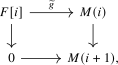
so that \(M(i+1)\) is the cofiber of \(\widetilde {g}\). Since the composite \(F[i] \to K(i) \to M(i) \to M\) is canonically nullhomotopic, there is an induced map \(f_{i+1}\colon M(i+1) \to M\). The induced fiber sequence \[ F[i] \longrightarrow K(i) \longrightarrow K(i+1) \] shows that \(\pi _jK(i+1)=0\) for \(j<i\), while the surjectivity of \(\pi _i(F[i]) \to \pi _i(K(i))\) gives \(\pi _iK(i+1)=0\). This verifies the inductive step.
It remains to prove that the natural map \(\colim _i M(i) \to M\) is an isomorphism. Since filtered colimits are exact in \(\Sp \), the fiber \(K\) of this map is \(\colim _i K(i)\). By property (iii), the group \(\pi _jK(i)\) vanishes for \(i>j\), and by Lemma 4.4.28 we conclude that \(\pi _j(K)=0\) for every \(j\). Hence \(K=0\).
The same construction with right free modules proves the assertion for connective right \(R\)-modules. □
Generated from the authoritative LaTeX source.