Proposition 2.3.10. Let \(f\colon Z \to X\) and \(g\colon Z \to Y\) be continuous maps, where all three spaces have the homotopy type of a cell complex. The canonical homotopy \(H_{\can }\) from Definition 2.1.3 determines a commutative square of animae
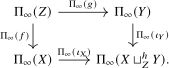
and this square is a pushout.
Proof. Consider the mapping cylinder of the map \(f\): \[ M(f) \quad := \quad (X \sqcup (Z \times [0,1])) / (z,0) \sim f(z). \] The map \(f\) factors as \(Z \xrightarrow {i} M(f) \xrightarrow {p} X\), where \(i(z) := [(z,1)]\), where \(p\vert _X = \id _X\) and where \(p\vert _{Z \times [0,1]}(z,t) := f(z)\). Observe that the map \(p\colon M(f) \to X\) is a homotopy equivalence, with homotopy inverse sending \(x\) to \([x]\). In particular, it induces an equivalence \(\Pi _{\infty }(M(f)) \iso \Pi _{\infty }(X)\) of animae. Further observe that the homotopy pushout \(X \sqcup _Z^h Y\) can be identified with the strict pushout \(M(f) \sqcup _Z Y\) via the maps \(g\) and the projection \(M(f) \to X\):
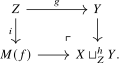
We will show that the functor \(\Pi _{\infty }\colon \Top \to \An \) preserves this pushout square.
Case 1: Assume first that the spaces \(X\), \(Y\) and \(Z\) are cell complexes and that the map \(f\) is a relative cell complex. In this case, the map \(i\colon Z \to M(f)\) is also a relative cell complex: it may be written as the composite of \(Z \times \{1\} \hookrightarrow Z \times [0,1]\), which is a relative cell complex by the product cell filtration, and the map \(Z \times [0,1] \to M(f)\), which is a pushout of the map \(Z \to X\) and hence also a relative cell complex. The fact that \(\Pi _{\infty }(-)\) preserves the pushout square in Equation 2.1 is now an instance of Proposition 2.3.9.
Case 2: We will now prove the general case. By Theorem 2.3.4, there exists a cell complex \(Z'\) and a weak homotopy equivalence \(Z' \iso Z\). By factorizing the composite maps \(Z' \to X\) and \(Z' \to Y\) into a relative cell complex followed by a weak equivalence, we obtain a commutative diagram
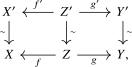
where \(X'\), \(Y'\) and \(Z'\) are cell complexes, the vertical maps are weak homotopy equivalences, and \(f'\) and \(g'\) are relative cell complexes. Since all six spaces have the homotopy type of a cell complex, it follows from Whitehead’s theorem that the vertical maps are even homotopy equivalences. By homotopy invariance of homotopy pushouts, Exercise 2.1.4, the induced map \(X' \sqcup _{Z'}^h Y' \to X \sqcup _Z^h Y\) is again a homotopy equivalence, and in particular it becomes an equivalence after applying \(\Pi _{\infty }(-)\). This means that we have reduced the problem to Case 1, thus finishing the proof. □
Generated from the authoritative LaTeX source.