Definition 2.2.7 (Left exact functor). Let \((C, W_C, F_C)\) and \((D, W_D, F_D)\) be \(\infty \)-categories with weak equivalences and fibrations. A functor \(F\colon C \to D\) is called left exact if:
- (1)
-
\(F\) preserves terminal objects.
- (2)
-
\(F\) sends fibrations between fibrant objects in \(C\) to fibrations in \(D\), and trivial fibrations between fibrant objects in \(C\) to trivial fibrations in \(D\).
- (3)
-
For any pullback square in \(C\)

in which \(p \in F_C\) and \(Y, Y'\) are fibrant in \(C\), the induced square
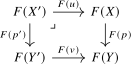
is a pullback square in \(D\).
If \(C, D\) have weak equivalences and cofibrations, we say that \(F\colon C \to D\) is right exact if \(F\catop \colon C\catop \to D\catop \) is left exact (relative to the dual fibration structures). In particular, \(F\) preserves initial objects and pushouts along cofibrations between cofibrant objects, provided that the other object in the span is also cofibrant.
Generated from the authoritative LaTeX source.