Lemma 2.3.17. The projection \(p\colon P(f) \to B\) given by \((e,\gamma ) \mapsto \gamma (1)\) is a Serre fibration.
Proof. Consider a solid commutative diagram of the form
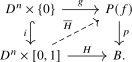
We may define the dashed map \(\overline {H}\) as \(\overline {H}(x,s) := (e(x),K(x,s,-))\), where
- The map \(e\colon D^n \to E\) is the first component of \(g\);
-
The map \(K \colon D^n \times [0,1] \times [0,1] \to B\) is a continuous map satisfying the following three constraints:
- To guarantee that \(\overline {H}(x,s) \in P(f)\) we need \(K(x,s,0) = f(e(x))\);
- To guarantee commutativity of the top triangle, we need \(K(x,0,t) = \gamma (x)(t)\), where \(\gamma (x)\) is the second component of \(g(x)\);
- To guarantee commutativity of the bottom triangle, we need \(K(x,s,1) = H(x,s)\).
Such a continuous map exists, since the inclusion \(\big ([0,1] \times \{0,1\}\big ) \cup \big (\{0\} \times [0,1]\big ) \hookrightarrow [0,1] \times [0,1]\) has a continuous retraction. □
Generated from the authoritative LaTeX source.