Corollary 7.3.6. For a spectrum \(X\), its \(p\)-completion is given by the following limit: \[ X^{\wedge }_p \quad \simeq \quad \lim (\,\,\dots \to X/p^3 \to X/p^2 \to X/p). \]
Proof. The exact sequence \(\S /p^n[-1] \to \S \xrightarrow {\cdot p^n} \S \) induces an exact sequence \[ \hom (\S ,X) \xrightarrow {\cdot p^n} \hom (\S ,X) \to \hom (\S /p^n[-1], X). \] Since \(\hom (\S ,X) \simeq X\), it follows that \(\hom (\S /p^n[-1], X) \simeq X/p^n\) for all \(n\). Furthermore, under these isomorphisms the maps \(\S /p^n \xrightarrow {\cdot p} \S /p^{n+1}\) induce the canonical maps \(X/p^{n+1} \to X/p^n\), as these are the ones induced on vertical cofibers in the following commutative diagram:
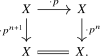
Using Theorem 7.3.5, we may then compute that \begin {align*} X^{\wedge }_p \simeq {} & \hom (\S /p^{\infty }[-1],X) \simeq \hom (\colim _n \S /p^n[-1],X) \\ \simeq & \lim _n \hom (\S /p^n[-1],X) \simeq \lim _n X/p^n, \end {align*}
as desired. □
Generated from the authoritative LaTeX source.