Proposition 2.4.26 (Puppe sequence). Given a fiber sequence \(F \xrightarrow {i} E \xrightarrow {p} B\) in \(\An _*\), there is a sequence \[ \dots \xrightarrow {\Omega ^2 p} \Omega ^2 B \xrightarrow {-\Omega \delta } \Omega F \xrightarrow {-\Omega i} \Omega E \xrightarrow {-\Omega p} \Omega B \xrightarrow {\delta } F \xrightarrow {i} E \xrightarrow {p} B, \] where each consecutive triple forms a fiber sequence.
Proof. To see that \(\Omega B\) is indeed the fiber of \(i\), consider the following commutative diagram:
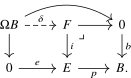
Here the outer square is the one defining \(\Omega B\), and the right square is obtained by flipping the given fiber sequence. The map \(\delta \) is induced by the universal property of the pullback \(F\), and it follows from the pasting law of pullback squares that also the left square is a pullback square, thus exhibiting \(\Omega B\) as the fiber of \(i\).
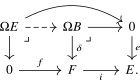
The rest of the Puppe sequence is obtained by iterating this argument indefinitely. The signs show up because in the iteration procedure we flip the homotopies in the squares; under the pullback description of loop objects, this amounts to composing with the inversion map defined above. For example, to determine the fiber of \(\delta \), we consider the following commutative diagram:
□
Generated from the authoritative LaTeX source.