Theorem 4.2.25 (Lurie (2009), Corollaries 4.4.2.4 and 4.4.2.5).
- (1)
-
An \(\infty \)-category \(C\) admits finite limits if and only if it has a terminal object and admits pullbacks.
- (2)
-
A functor \(F\colon C \to D\) is left exact if and only if it preserves terminal objects and pullbacks.
Dually \(C\) has finite colimits if and only if it has an initial object and admits pushouts, and \(F\) preserves finite colimits if and only if it preserves initial objects and pushouts.
Proof. Stable \(\infty \)-categories have zero objects and pullbacks/pushouts, and therefore finite products (\(X \times Y = X \times _0 Y\)) and coproducts (\(X \sqcup Y = X \sqcup _0 Y\)). Additivity of \(C\) then amounts to showing that for all objects \(X\) and \(Y\) in \(C\), the two commutative squares

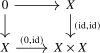
are exact. To see this, we consider the following two diagrams:
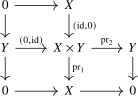
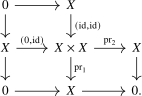
In both cases, the right bottom square, the bottom rectangle and the left rectangle are pullback squares, and hence by the pasting law for pullback diagrams also the upper left square is exact. This finishes the proof. □
Generated from the authoritative LaTeX source.