Definition 2.3.1. A continuous map \(i\colon A \to X\) is called a relative cell complex if it is isomorphic under \(A\) to a map obtained by iteratively attaching cells: there exists an ordinal \(\lambda \), a sequence \((X_{\alpha })_{\alpha \leq \lambda }\) and a homeomorphism \(X_{\lambda } \cong X\) under \(A\) such that
- \(X_0 = A\);
- For \(\alpha < \lambda \), \(X_{\alpha +1}\) is formed from \(X_{\alpha }\) via a pushout square for some index set \(I_\alpha \) and dimensions \(n_j \geq 0\).
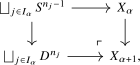
- For limit ordinals \(\beta \leq \lambda \), \(X_{\beta } = \colim _{\alpha < \beta } X_{\alpha }\).
A topological space \(X\) is a cell complex if the map \(\emptyset \to X\) is a relative cell complex. We denote by \(\mathrm {Cell} \subseteq \Top \) the full subcategory spanned by the cell complexes.
Generated from the authoritative LaTeX source.