Lemma 2.4.29 (Sequential colimits as pushouts). Let \(C\) be an \(\infty \)-category with countable coproducts and pushouts, and let \(Z_0 \xrightarrow {f_0} Z_1 \xrightarrow {f_1} Z_2 \xrightarrow {f_2} \cdots \) be a sequence in \(C\). Its colimit exists and may be computed as the pushout
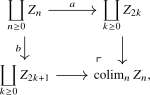
where on the summand \(Z_n\) the maps \(a\) and \(b\) are defined as follows. If \(n = 2k\) is even, then \(a\) is the inclusion \(\id \colon Z_{2k} \to Z_{2k}\) of a coproduct summand and \(b\) is the map \(f_{2k}\colon Z_{2k} \to Z_{2k+1}\); if \(n = 2k+1\) is odd, then \(a\) is the map \(f_{2k+1}\colon Z_{2k+1} \to Z_{2k+2}\) and \(b\) is the inclusion \(\id \colon Z_{2k+1} \to Z_{2k+1}\).
Proof. Let \(P\) denote the displayed pushout. For every object \(T\in C\), mapping from \(P\) to \(T\) gives the pullback of the animae of maps from the coproducts of the even and odd terms over the anima of maps from all terms. By the pushout description of \([\omega ]\) in Axiom D, this is precisely the anima of cocones from the sequence \((Z_n)_n\) to \(T\). Thus \(P\) has the universal property of \(\colim _n Z_n\). □
Generated from the authoritative LaTeX source.