Lemma 2.4.8. The functor \(\Sigma \colon \An _* \to \An _*\) is left adjoint to \(\Omega \colon \An _* \to \An _*\): for all \(X,Y \in \An _*\) there is a natural equivalence \[ \Hom _{\An _*}(\Sigma X,Y) \simeq \Hom _{\An _*}(X,\Omega Y). \]
Proof. Applying the contravariant functor \(\Hom _{\An _*}(-,Y)\) to the pushout defining \(\Sigma X\), and the covariant functor \(\Hom _{\An _*}(X,-)\) to the pullback defining \(\Omega Y\), gives pullback squares
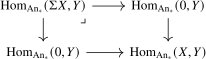
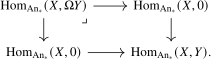
Since \(0\) is both initial and terminal, the copies of \(\Hom _{\An _*}(0,Y)\) and \(\Hom _{\An _*}(X,0)\) are contractible. The maps from them to \(\Hom _{\An _*}(X,Y)\) select the zero morphism \(X \to 0 \to Y\), and it follows that \[ \Hom _{\An _*}(\Sigma X,Y) \simeq * \times _{\Hom _{\An _*}(X,Y)} * \simeq \Hom _{\An _*}(X,\Omega Y). \] Both of these equivalences are natural contravariantly in \(X\) and covariantly in \(Y\), proving the adjunction. □
Generated from the authoritative LaTeX source.