Theorem 3.2.6 (Brown representability, Brown (1962), Switzer (1975)). For every reduced cohomology theory \((h^*,\sigma )\), there is a spectrum \(E\) and a natural isomorphism \(h^*\iso \widetilde E^*\) compatible with the suspension isomorphisms. Moreover, every natural transformation \(\widetilde E^*\to \widetilde F^*\) of reduced cohomology theories that commutes with the suspension isomorphisms is induced by a morphism of spectra \(E\to F\).
Proof of Theorem 3.2.6. Let \((h^*,\sigma )\) be a reduced cohomology theory. For each \(m\geq 0\), the restriction of \(h^m\) to connected pointed animae satisfies the wedge axiom by definition and the Mayer–Vietoris property by Lemma 3.4.6. The abstract Brown representability theorem, Theorem 3.4.3, gives a connected pointed anima \(Y_m\) and a natural isomorphism \[ h^m(X)\cong [X,Y_m]_* \] on connected pointed animae.
Set \[ E_m:=\Omega Y_{m+1}\qquad (m\geq 0). \] Since \(\Sigma X\) is connected for every pointed anima \(X\), the suspension isomorphism gives natural isomorphisms \[ h^m(X)\cong h^{m+1}(\Sigma X)\cong [\Sigma X,Y_{m+1}]_*\cong [X,E_m]_* \] for every pointed anima \(X\). Thus \(E_m\) represents \(h^m\) on all of \(\An _*\). The same calculation shows that \(\Omega E_{m+1}\) also represents \(h^m\). The Yoneda lemma therefore supplies an isomorphism \[ E_m\iso \Omega E_{m+1} \] compatible with the given suspension isomorphism. These isomorphisms make \((E_m)_{m\geq 0}\) into a spectrum \(E\). The representing isomorphisms identify \(h^k\) with \(\widetilde E^k\) for \(k\geq 0\), and for \(k<0\) we obtain \[ \widetilde E^k(X) =[X,\Omega ^{-k}E_0]_* \cong h^0(\Sigma ^{-k}X) \cong h^k(X). \] This proves the first assertion.
Now let \(\alpha \colon \widetilde E^*\to \widetilde F^*\) be a natural transformation commuting with suspension. For each \(m\geq 0\), the degree-\(m\) component is a natural transformation \[ [-,E_m]_*\longrightarrow [-,F_m]_*, \] so Chapterexercise 3.1 identifies it with postcomposition by a unique homotopy class of pointed maps \(f_m\colon E_m\to F_m\). Compatibility with suspension says precisely that the squares
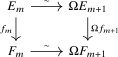
commute in \(\Ho (\An _*)\). Choosing representatives and the corresponding homotopies gives a morphism of spectra \(f\colon E\to F\) in the sense of Definition 3.2.2. Its induced natural transformation is \(\alpha \) in nonnegative degrees, and hence in every degree by compatibility with suspension. □
Generated from the authoritative LaTeX source.