Discussion 5.1.10. The existence of the right adjoint \(j_*\) to \(j^*\) follows from the pointwise formula for Kan extensions from Theorem 21.4.3. Given a morphism in \(C\) of the form \(f\colon [1] \to C\), the pointwise formula says that the value of \(j_*(f)\colon \simp \catop _+ \to C\) at \([n] \in \simp _+\) is given by the limit \(\lim _{I_n} f_n\), where \(I_n\) is the full subcategory of the slice \(((\simp _+)_{/[n]})\catop \) spanned by all objects of the form \([-1] \to [n]\) and \([0] \to [n]\), and where \(f_n\) is the composite \(I_n \to [1] \xrightarrow {\smash {f}} C\). Since there is a unique map \(\infty \colon [-1] \to [n]\) and there is one map \(i\colon [0] \to [n]\) for every \(0 \leq i \leq n\), the category \(I_n\) may be identified with the following poset:
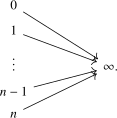
The forgetful functor \(I_n \to [1]\) sends \(\infty \) to \(1\) and sends each \(0 \leq i \leq n\) to \(0\). In particular, the functor \(f_n\colon I_n \to C\) takes the form
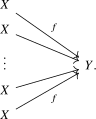
Since \(C\) admits pullbacks, the limit of this diagram exists in \(C\) and is given by the \((n+1)\)-fold fiber product of \(X\) with itself over \(Y\). All in all, we see that the Čech nerve of a morphism \(f\colon X \to Y\) in \(C\) is well-defined and is given in degree \(n\) by \[ \check {C}_n(f) \quad \simeq \quad X^{\times ^{n+1}_Y} \quad = \quad X \times _{Y} X \times _{Y} \dots \times _Y X. \]
Generated from the authoritative LaTeX source.