Proposition 5.3.20. Let \(C\) be an \(\infty \)-category with finite products. Then the \(\infty \)-category \(\CMon (C)\) is semiadditive. The subcategory \(\CGrp (C)\) is even additive.
Proof. We first show that \(\CMon (C)\) is semiadditive. This amounts to two claims: first, \(\CMon (C)\) has a zero object, and second, finite products are also coproducts.
For the first claim, note that \(\Span (\Fin )\) is pointed, with zero object given by the empty set. By Corollary 4.1.12, the \(\infty \)-category \(\Fun _*(\Span (\Fin ),C)\) is pointed, with zero object given by the constant functor \(\const _*\colon \Span (\Fin ) \to C\). Since \(\CMon (C) \subseteq \Fun _*(\Span (\Fin ),C)\) is the full subcategory spanned by the finite-product-preserving functors and contains \(\const _*\), this same object is also a zero object of \(\CMon (C)\).
For the second claim, we show that for commutative monoids \(X\) and \(Y\), the product \(X \times Y\) equipped with the maps \((\id _X,0)\colon X \to X \times Y\) and \((0,\id _Y)\colon Y \to X \times Y\) is also a coproduct. In other words, we need to show that the corresponding natural transformation \[ ((\id _X,0), (0,\id _Y))\colon (X,Y) \to (X \times Y, X \times Y) = \Delta (X \times Y) \] is the unit of an adjunction between the product functor and the diagonal functor \(\Delta \colon \CMon (C) \to \CMon (C) \times \CMon (C)\) (with the product being the left adjoint!). By Proposition 21.1.2, it suffices to supplement this unit by a counit satisfying the triangle identities. We therefore have to produce for every third commutative monoid \(Z\) a compatible counit map \[ m_Z\colon Z \times Z \to Z \] satisfying the triangle identities; this is the map that will a posteriori correspond to the fold map \(Z \oplus Z \to Z\). Using the cotensoring from Lemma 5.3.19, we define \(m_Z\) as the composite \[ m_Z\colon Z \times Z \cong Z^{* \sqcup *} \xrightarrow {Z^{\nabla }} Z^* \cong Z, \] where \(\nabla \colon * \sqcup * \to *\) is the fold map in \(\Fin \), viewed as a span \((* \sqcup * \xleftarrow {\id } * \sqcup * \xrightarrow {\nabla } *)\). The triangle identities take the following form:
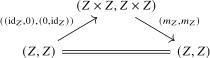
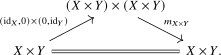
For the right-hand triangle, we use that the cotensoring preserves products, so that the map \(m_{X \times Y}\) may be rewritten as the product map \[ m_X \times m_Y \colon (X \times X) \times (Y \times Y) \to X \times Y. \] We then see that to produce both triangles, it suffices to produce for every \(X \in \CMon (C)\) two natural homotopies between the composites \[ X \xrightarrow {(\id _X,0)} X \times X \xrightarrow {m_X} X, \qquad X \xrightarrow {(0,\id _X)} X \times X \xrightarrow {m_X} X \] and the identity on \(X\). For this, observe that we may write the zero map \(0\colon \const _* \to X\) as the map \(X^{\emptyset } \to X^*\) induced on cotensorings by the inclusion \(\emptyset \hookrightarrow *\) in \(\Fin \). Consequently, under the isomorphism \(X^* \times X^* \cong X^{*\sqcup *}\), the maps \((\id _X,0)\) and \((0,\id _X)\) are induced by the two inclusions \(\iota _1,\iota _2\colon * \hookrightarrow *\sqcup *\). The triangle identities then reduce to the observation that the two composites in \(\Fin \)


are both the identity, which is immediate. This proves that \(\CMon (C)\) is semiadditive.
Finally, \(\CGrp (C) \subseteq \CMon (C)\) is closed under finite products and contains the zero object, so the biproducts constructed above restrict to \(\CGrp (C)\). Their fold map is the algebraic addition \(m_M\) constructed above. Hence the additive shear map agrees with the algebraic shear map of Definition 5.3.6, which is invertible by definition. Thus \(\CGrp (C)\) is additive. □
Generated from the authoritative LaTeX source.