Lemma 9.2.9. Let \(\pi \colon P \to B\) be a principal \(G\)-bundle. Then for every \(n \geq 0\) the continuous map \[ \Phi _n\colon P \times G^n \to P \times _B P \times _B \dots \times _B P, \qquad (p,g_1, \dots , g_n) \mapsto (p, pg_1, \dots , pg_1\dots g_n) \] is a homeomorphism.
Proof. By induction we may immediately reduce to the case \(n = 1\), i.e. we must show that the map \(\Phi _1\colon P \times G \to P \times _B P, \, (p,g) \mapsto (p,pg)\) is a homeomorphism. Observe that this map fits in a commutative diagram of the form
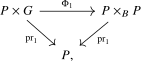
and so it suffices to find an open cover of \(P\) such that the given map restricts to a homeomorphism on the preimages. Since \(\pi \) is locally trivial, we may thus assume that it is of the form \(\pr \colon B \times G \to B\). But in this case, the map \(\Phi _1\) takes the form \(B \times G \times G \to B \times G \times G, \, (b,g,h) \mapsto (b,g,gh)\), which is indeed a homeomorphism with inverse \((b,g,h') \mapsto (b,g,g^{-1}h')\). □
Generated from the authoritative LaTeX source.