For paracompact Hausdorff spaces, vector bundles are classified by maps into Grassmannians: there exists a topological space \(\Gr _k(\C ^{\infty })\) such that an isomorphism class of rank \(k\) complex vector bundle over \(X\) determines and is determined by a homotopy class of continuous maps from \(X\) into \(\Gr _k(\C ^{\infty })\). The goal of this section is to explain this result and relate the space \(\Gr _k(\C ^{\infty })\) to the classifying anima \(\bB U(k)\) of the topological group \(U(k)\).
9.2.1 The infinite Grassmannian
Definition 9.2.1 (Infinite grassmannian). Let \(\C ^{\infty }\) denote the colimit in \(\Top \) of the complex vector spaces \(\C ^n\) along the standard inclusions \(\C ^n\hookrightarrow \C ^{n+1}\). For \(n\geq k\), let \(\Gr _k(\C ^n)\) be the Grassmannian of \(k\)-dimensional linear subspaces of \(\C ^n\), with its usual topology. We define the infinite Grassmannian of \(k\)-planes as \[ \Gr _k(\C ^{\infty }) := \bigcup _{n\geq k}\Gr _k(\C ^n), \] equipped with the colimit topology: a subset \(U\subseteq \Gr _k(\C ^\infty )\) is open if and only if \(U\cap \Gr _k(\C ^n)\) is open for every \(n\).
Similarly, let \(V_k(\C ^n)\) be the Stiefel manifold of orthonormal \(k\)-frames in \(\C ^n\). The infinite Stiefel manifold \[ V_k(\C ^{\infty }) := \bigcup _{n\geq k}V_k(\C ^n) \] is likewise given the colimit topology. Its points may equivalently be regarded as linear isometric embeddings \(\C ^k\hookrightarrow \C ^\infty \). Sending a frame to the subspace it spans defines a surjective map \[ \pi \colon V_k(\C ^{\infty }) \to \Gr _k(\C ^{\infty }), \qquad (\phi \colon \C ^k \hookrightarrow \C ^{\infty }) \mapsto \phi (\C ^k), \] whose restriction at every finite stage is the usual quotient map \(V_k(\C ^n)\to \Gr _k(\C ^n)\).
The standard Schubert cell structures on the finite Grassmannians are compatible with the inclusions above. Consequently \(\Gr _k(\C ^\infty )\) is a cell complex whose topology is precisely the colimit topology just defined; see Hatcher (2003), Proposition 1.17 and p. 34.
Definition 9.2.2. For \(n\geq k\), let \[ E_{k,n}:=\{(V,x)\in \Gr _k(\C ^n)\times \C ^n\mid x\in V\} \] be the canonical rank \(k\) bundle over \(\Gr _k(\C ^n)\). We define \[ E_{\univ }:=\bigcup _{n\geq k}E_{k,n} \] with the colimit topology, and let \(p_{\univ }\colon E_{\univ }\to \Gr _k(\C ^\infty )\) be the projection \((V,x)\mapsto V\).
Proof. Fix a \(k\)-plane \(V\subseteq \C ^\infty \) and let \(U_V\) be the set of \(k\)-planes \(W\) for which the orthogonal projection \(W\to V\) is an isomorphism. Its intersection with every finite Grassmannian is open, so \(U_V\) is open in the colimit topology. Every \(W\in U_V\) is the graph of a unique linear map \(a_W\colon V\to V^\perp \), depending continuously on \(W\). The maps \[ U_V\times V\longrightarrow p_{\univ }^{-1}(U_V), \qquad (W,v)\longmapsto (W,v+a_W(v)) \] are therefore local trivializations of \(p_{\univ }\). □
Let \(X\) be a paracompact Hausdorff space. Given a continuous map \(f\colon X \to \Gr _k(\C ^{\infty })\), we may pull back the bundle \(E_{\univ }\) along \(f\), providing a vector bundle \[ f^*(E_{\univ }) := \{(x,\phi ) \in X \times E_{\univ } \mid f(x) = p_{\univ }(\phi )\}. \] By Theorem 9.1.4, the isomorphism class of this vector bundle only depends on the homotopy class of \(f\), providing a map \begin {equation} \label {eq:Grassmannian_Classifies_Vector_Bundles} [X,\Gr _k(\C ^{\infty })] \to \pi _0\Vect _k(X), \qquad [f] \mapsto f^*(E_{\univ }). \end {equation}
The following classical theorem expresses that \(p_{\univ }\) is the universal rank \(k\) complex vector bundle:
Theorem 9.2.4 (Hatcher (2003), Theorem 1.16 and p. 31). For a paracompact Hausdorff space \(X\), the map (9.1) is a bijection.
Because of this theorem, \(\Gr _k(\C ^{\infty })\) is known as the classifying space for rank \(k\) complex vector bundles.
Proof sketch of Theorem 9.2.4. We describe the main ingredients of Hatcher’s argument. The key observation is that, for a rank \(k\) vector bundle \(p\colon E \to X\), the following two types of data are equivalent:
- (1)
-
A pair \((f,\phi )\) consisting of a continuous map \(f\colon X \to \Gr _k(\C ^\infty )\) and an isomorphism \(\phi \colon E \cong f^*(E_{\univ })\);
- (2)
-
A continuous map \(g\colon E \to \C ^\infty \) whose restriction to each fiber is a \(\C \)-linear injection.
Indeed, an isomorphism \(E \cong f^*(E_{\univ })\) gives such a map by projecting \(f^*(E_{\univ }) \subseteq X \times \C ^\infty \) to \(\C ^\infty \). Conversely, a fiberwise linear injection \(g\) determines \(f(x) := g(E_x) \subseteq \C ^\infty \), and the evident map \(E \to E_{\univ }\) identifies \(E\) with \(f^*(E_{\univ })\).
Surjectivity is therefore reduced to constructing a map \(g\colon E\to \C ^\infty \) which is linear and injective on each fiber. Starting from a trivializing cover, one uses the countable-cover lemma for paracompact spaces to obtain a countable trivializing cover \((U_i)_{i\geq 1}\) together with a locally finite subordinate partition of unity \((\rho _i)_{i\geq 1}\). Let \(g_i\colon E|_{U_i}\to \C ^k\) be the coordinate map of a trivialization. The maps \[ v\longmapsto \rho _i(p(v))g_i(v), \] extended by zero outside \(U_i\), assemble into a map \(E\to (\C ^k)^\infty \cong \C ^\infty \). Local finiteness ensures that this map is continuous and takes values in the algebraic direct sum, while the partition-of-unity condition makes it injective on every fiber. This is the only point at which paracompactness is used in an essential way.
For injectivity, suppose two classifying maps \(f_0,f_1\colon X \to \Gr _k(\C ^\infty )\) pull back \(E_{\univ }\) to isomorphic bundles. The corresponding fiberwise injections \(g_0,g_1\colon E \to \C ^\infty \) may first be homotoped so that their images land in the odd and even coordinates, respectively. The straight-line homotopy \((1-t)g_0+tg_1\) then remains fiberwise injective for all \(t\), and hence determines a homotopy from \(f_0\) to \(f_1\).
For the countable-cover lemma, see Hatcher (2003), Lemma 1.21; the remaining continuity details are part of the proof of Hatcher (2003), Theorem 1.16. □
9.2.2 Classifying animae revisited
Recall that in Construction 5.1.14 we defined the classifying anima \(\bB G\) of a group object \(G \in \Grp (\An )\). To identify the underlying anima of the infinite Grassmannian, we develop a general recognition criterion for classifying animae. The same criterion will be reused for real vector bundles in Chapter 10.
Recall from Corollary 2.3.20 that the functor \(\Pi _{\infty }\colon \Top \to \An \) preserves finite products, hence induces a functor \[ \Pi _{\infty }\colon \Grp (\Top ) \to \Grp (\An ) \] from the category of topological groups to the \(\infty \)-category of group objects in animae.
Definition 9.2.5. For a topological group \(G\), we define its classifying anima \(\bB G\) as \[ \bB G \quad := \quad \bB \Piinfty {G} \qin \An . \]
We will now discuss a concrete way of recognizing topological spaces whose underlying anima is isomorphic to \(\bB G\).
Definition 9.2.6 (Principal bundle). Let \(G\) be a topological group and let \(B\) be a topological space. The trivial \(G\)-principal bundle is the projection map \(B \times G \to B\), where we equip \(B \times G\) with the canonical right \(G\)-action given by \((b,g)g' := (b,gg')\).
A \(G\)-principal bundle is a continuous map \(\pi \colon P \to B\) such that \(P\) is equipped with a continuous right \(G\)-action such that:
- (1)
-
The right \(G\)-action on \(P\) preserves the fibers of \(\pi \): we have \(\pi (pg) = \pi (p)\) for all \(p \in P\) and \(g \in G\);
- (2)
-
The map \(\pi \) is a locally trivial bundle: around every point \(b \in B\) there is an open neighborhood \(b \in U \subseteq B\) such that the restriction \(\pi ^{-1}(U) \to U\) of \(\pi \) is a trivial \(G\)-principal bundle, i.e. there exists a \(G\)-equivariant homeomorphism \(\phi \colon U \times G \xrightarrow {\cong } \pi ^{-1}(U)\) over \(U\):
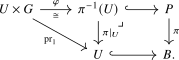
We refer to \(P\) as the total space, to \(G\) as the structure group, and to \(B\) as the base space.
Proposition 9.2.7 (Principal bundles and vector bundles). Every principal \(\GL _n(\C )\)-bundle \(P \to B\) defines a complex vector bundle of rank \(n\) over \(B\) by taking \[ E := P \times _{\GL _n(\C )} \C ^n = (P \times \C ^n)_{/(p,Av) \sim (pA,v)}, \] where the equivalence relation identifies the pair \((p,Av)\) with \((pA,v)\) for all \(p \in P\), \(v \in \C ^n\) and \(A \in \GL _n(\C )\). This construction defines a bijection between the set of isomorphism classes of principal \(\GL _n(\C )\)-bundles and the set of isomorphism classes of rank \(n\) vector bundles.
Proof. Local trivializations of \(P\) induce local trivializations of the associated bundle. Conversely, the frame bundle \(\mathrm {Fr}(E)\to B\) of a rank \(n\) vector bundle is a principal \(\GL _n(\C )\)-bundle. The natural map \(\mathrm {Fr}(E)\times _{\GL _n(\C )}\C ^n\to E\) is an isomorphism, and the map \[ P\longrightarrow \mathrm {Fr}(P\times _{\GL _n(\C )}\C ^n), \qquad p\longmapsto \big (v\mapsto [p,v]\big ) \] is an isomorphism of principal bundles. Thus the two constructions are inverse on isomorphism classes. □
Remark 9.2.8. Since \(\pi \colon P \to B\) is locally trivial, hence locally a Serre fibration, it follows from Theorem 2.3.13 that every principal bundle is a Serre fibration. In particular, the functor \(\Pi _{\infty }\) preserves pullbacks along principal bundles by Proposition 2.3.19.
Lemma 9.2.9. Let \(\pi \colon P \to B\) be a principal \(G\)-bundle. Then for every \(n \geq 0\) the continuous map \[ \Phi _n\colon P \times G^n \to P \times _B P \times _B \dots \times _B P, \qquad (p,g_1, \dots , g_n) \mapsto (p, pg_1, \dots , pg_1\dots g_n) \] is a homeomorphism.
Proof. By induction we may immediately reduce to the case \(n = 1\), i.e. we must show that the map \(\Phi _1\colon P \times G \to P \times _B P, \, (p,g) \mapsto (p,pg)\) is a homeomorphism. Observe that this map fits in a commutative diagram of the form
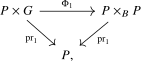
and so it suffices to find an open cover of \(P\) such that the given map restricts to a homeomorphism on the preimages. Since \(\pi \) is locally trivial, we may thus assume that it is of the form \(\pr \colon B \times G \to B\). But in this case, the map \(\Phi _1\) takes the form \(B \times G \times G \to B \times G \times G, \, (b,g,h) \mapsto (b,g,gh)\), which is indeed a homeomorphism with inverse \((b,g,h') \mapsto (b,g,g^{-1}h')\). □
Observe that both sides of Lemma 9.2.9 define simplicial objects in \(\Top \). The simplicial structure on the right-hand side is that of the Čech nerve \(\check {C}(\pi )\), see the proof of Proposition 5.1.15. The one on the left is the bar construction associated to the right action of \(G\) on \(P\), with face maps \begin {align*} d_0(p,g_1,\dots ,g_n) &= (pg_1,g_2,\dots ,g_n), \\ d_i(p,g_1,\dots ,g_n) &= (p,g_1,\dots ,g_ig_{i+1},\dots ,g_n) && (0<i<n), \\ d_n(p,g_1,\dots ,g_n) &= (p,g_1,\dots ,g_{n-1}), \end {align*}
and degeneracy maps \[ s_i(p,g_1,\dots ,g_n)=(p,g_1,\dots ,g_i,e,g_{i+1},\dots ,g_n) \qquad (0\leq i\leq n), \] where the initial string \(g_1,\dots ,g_i\) is empty when \(i=0\).
Lemma 9.2.10. The homeomorphisms \(\Phi _n\) from Lemma 9.2.9 define an isomorphism of simplicial objects in \(\Top \).
Proof. It suffices to check the face and degeneracy maps. For the first face map, we have \begin {align*} \Phi _{n-1}(d_0^*(p,g_1,\dots ,g_n)) &=\Phi _{n-1}(pg_1,g_2,\dots ,g_n) \\ &=(pg_1,pg_1g_2,\dots ,pg_1g_2\dots g_n) =d_0^*\Phi _n(p,g_1,\dots ,g_n). \end {align*}
For a degeneracy map, inserting the identity element among the \(g_i\) inserts a repeated partial product among \(p,pg_1,\dots ,pg_1\dots g_n\), as required. The remaining face maps either multiply two adjacent \(g_i\) or omit the last one, and the same direct calculation proves compatibility. □
We now get to the promised result about recognizing topological spaces whose underlying anima is of the form \(\bB G\):
Proposition 9.2.11. Let \(\pi \colon P \to B\) be a principal \(G\)-bundle such that \(P\) is contractible.
- (1)
-
The Čech nerve of \(\Pi _{\infty }(\pi )\colon \Pi _{\infty }(P) \to \Pi _{\infty }(B)\) is isomorphic to \(\Pi _{\infty }(G) \in \Grp (\An )\);
- (2)
-
In particular, passing to colimits provides an isomorphism of animae \[ \Pi _{\infty }(B) \iso \bB G. \]
Proof. A principal bundle is a locally trivial fiber bundle and hence a Serre fibration by Theorem 2.3.13. Since \(\Pi _{\infty }\colon \Top \to \An \) preserves pullbacks along Serre fibrations by Proposition 2.3.19, there are isomorphisms \[ \Piinfty {P \times _B \dots \times _B P} \iso \Piinfty {P} \times _{\Piinfty {B}} \dots \times _{\Piinfty {B}} \Piinfty {P} \] for all \(n\), which assemble into an isomorphism of simplicial animae \(\Piinfty {\check {C}(\pi )} \iso \check {C}(\Piinfty {\pi })\). By Lemma 9.2.10, the simplicial anima \(\Piinfty {\check {C}(\pi )}\) is isomorphic to \([n] \mapsto \Piinfty {P \times G^n}\). By contractibility of \(P\), the projection maps \(\Piinfty {P \times G^n} \cong \Pi _{\infty }(P) \times \Piinfty {G^n} \to \Piinfty {G^n}\) are isomorphisms, which are compatible with the simplicial structure maps (see Chapterexercise 5.1). This proves part (1). For part (2), observe that \(\Pi _{\infty }(\pi )\) is surjective on path components, since \(\pi \) is surjective. It is therefore an effective epimorphism of animae, so \(\Pi _{\infty }(B)\) is the colimit of its Čech nerve. On the other hand, the colimit of the simplicial anima underlying the group object \(\Pi _{\infty }(G)\) is its classifying anima \(\bB G\). Part (1) therefore gives the claimed isomorphism. □
9.2.3 The infinite Grassmannian as a classifying anima
We now return to the infinite Grassmannian: we wish to apply Proposition 9.2.11 to the map \(\pi \colon V_k(\C ^{\infty }) \to \Gr _k(\C ^{\infty })\) to conclude that \(\Gr _k(\C ^{\infty })\) is a geometric model for the classifying anima of the unitary group \(U(k)\), the group of complex isometries \(\C ^k \xrightarrow {\cong } \C ^k\).
Lemma 9.2.12. The projection map \(\pi \colon V_k(\C ^{\infty }) \to \Gr _k(\C ^{\infty })\) is a principal \(U(k)\)-bundle. Here \(U(k)\) acts on \(V_k(\C ^{\infty })\) by precomposition: given \(A \in U(k)\) and \(\phi \colon \C ^k \hookrightarrow \C ^{\infty }\), we define \(\phi A\) as the composite \(\C ^k \xrightarrow {A} \C ^k \xrightarrow {\phi } \C ^{\infty }\).
Proof. Let \(W \in \Gr _k(\C ^{\infty })\), and define \(U \subseteq \Gr _k(\C ^{\infty })\) to be the subspace of those \(k\)-planes \(V\) for which the orthogonal projection \(W \to V\) is an isomorphism. This is open: its intersection with every finite-dimensional stage \(\Gr _k(\C ^n)\) is open, and \(\Gr _k(\C ^{\infty })\) has the colimit topology. We claim that there exists a \(U(k)\)-equivariant homeomorphism \[ \phi \colon U \times U(k) \xrightarrow {\cong } \pi ^{-1}(U) \] over \(U\), which will suffice to finish the proof. To construct \(\phi \), fix a \(k\)-frame \((w_1, \dots , w_k)\) for \(W\). Given any \(k\)-plane \(V \in U\), the projection \(W \to V\) is an isomorphism, hence sends the \(k\)-frame \((w_1, \dots , w_k)\) to some basis for \(V\). Using Gram-Schmidt orthonormalization (which is a continuous operation), we may turn this into a \(k\)-frame \((v_1, \dots , v_k)\) for \(V\). All in all, we may then define \[ \phi (V,A) := (v_1, \dots , v_k) \circ A. \] Bijectivity of \(\phi \) holds because two orthonormal frames of a \(k\)-plane differ by a unique unitary \((k \times k)\)-matrix. We leave it to the reader to check that this is indeed a well-defined homeomorphism over \(U\). □
Remark 9.2.13. Under the bijection of Proposition 9.2.7, the principal bundle \(V_k(\C ^{\infty }) \to \Gr _k(\C ^{\infty })\) is in fact the principal bundle associated to the universal rank \(k\) vector bundle \(E_{\univ }\) from Definition 9.2.2.
Proof. Consider the space \(\widetilde {V}_k(\C ^{\infty })\) of all linear injections \(\C ^k \hookrightarrow \C ^{\infty }\) which are not necessarily isometries. Equivalently, \(\widetilde {V}_k(\C ^{\infty })\) is the topological space of \(k\)-tuples \((v_1, \dots , v_k)\) of linearly independent vectors in \(\C ^{\infty }\) which are not necessarily orthogonal to each other. Observe that the inclusion \(V_k(\C ^{\infty }) \hookrightarrow \widetilde {V}_k(\C ^{\infty })\) is a homotopy equivalence: the Gram-Schmidt orthogonalization procedure provides a deformation retract \(\widetilde {V}_k(\C ^{\infty }) \to V_k(\C ^{\infty })\).
It will thus suffice to show that \(\widetilde {V}_k(\C ^{\infty })\) is contractible. To this end, consider the ‘shift map’ \(T^k\colon \C ^{\infty } \to \C ^{\infty }\) given on basis vectors by \(T^k(e_n) := e_{n+k}\). This induces a map \(T^k\colon \widetilde {V}_k(\C ^{\infty }) \to \widetilde {V}_k(\C ^{\infty })\). Note that this map is homotopic to the constant map on \((e_1, \dots , e_k)\) via the straight-line homotopy: \[ H(v,t) := (1-t)(e_1, \dots , e_k) + t T^k(v). \] This is well-defined since the first \(k\) components of the vectors \(T^k(v_i)\) are all zero. Similarly, the map \(T^k\) is homotopic to the identity on \(\widetilde {V}_k(\C ^{\infty })\), again via the straight-line homotopy: \[ H(v,t) := (1-t)v + t T^k(v). \] To see that this is well-defined, assume for contradiction that for some time \(t\) the vectors are no longer linearly independent. Then there are scalars \(\lambda _1, \dots , \lambda _k\), not all zero, such that \(\sum _{i=1}^k \lambda _i ((1-t)v_i + t T^k(v_i)) = 0\). But then the nonzero vector \(w := \sum _{i=1}^k\lambda _i v_i\) satisfies \((1-t) w + t T^k(w) = 0\). For \(t<1\), this is impossible by considering the first nonzero coordinate of \(w\); for \(t=1\), it is impossible because \(T^k\) is injective. This contradicts linear independence of \(v\).
It follows that the identity on \(\widetilde {V}_k(\C ^{\infty })\) is homotopic to a constant map, and hence this space is contractible. □
Writing \(U(k)\) also for the underlying anima of the topological group \(U(k)\), we get:
Corollary 9.2.15. The underlying anima of the Grassmannian \(\Gr _k(\C ^{\infty })\) is isomorphic to the classifying anima \(\bB U(k)\).
Proof. In light of Lemma 9.2.12 and Lemma 9.2.14, this is an instance of Proposition 9.2.11. □
Corollary 9.2.16. Let \(X\) be a paracompact Hausdorff space. There is a natural bijection \[ \left [X,\bigsqcup _{k=0}^{\infty }\Gr _k(\C ^\infty )\right ] \xrightarrow {\cong } \pi _0 \Vect (X). \] If \(X\) is a cell complex, this bijection can equivalently be written as \[ \pi _0\Hom _{\An }\left (\Pi _{\infty }X,\bigsqcup _{k=0}^{\infty }\bB U(k)\right ) \xrightarrow {\cong } \pi _0\Vect (X). \]
Proof. Both sides of the first bijection decompose according to locally constant functions \(r\colon X\to \N \). For such a function, let \(X_k:=r^{-1}(k)\). These subspaces are clopen, and hence paracompact Hausdorff, and they form a topological disjoint-union decomposition \[ X=\bigsqcup _{k\geq 0}X_k. \] A continuous map \(X\to \bigsqcup _{k\geq 0}\Gr _k(\C ^\infty )\) with component function \(r\) is precisely a family of continuous maps \(X_k\to \Gr _k(\C ^\infty )\). Similarly, a vector bundle with rank function \(r\) is precisely a family of rank \(k\) vector bundles over the \(X_k\). The first bijection therefore follows on each clopen stratum from Theorem 9.2.4.
The Schubert cell structures above also make \(\bigsqcup _{k\geq 0}\Gr _k(\C ^\infty )\) a cell complex. If \(X\) is a cell complex as well, then Corollary 2.3.7, Corollary 9.2.15 identifies the source of the first bijection with the source of the second. □
Remark 9.2.17. More generally, for every topological group \(G\) there exists a topological space \(BG\) together with a principal \(G\)-bundle \(EG \to BG\) whose total space \(EG\) is contractible. In [Husemoller (1993), Section 4.12], it is shown that Milnor’s construction of \(BG\) classifies principal \(G\)-bundles on paracompact Hausdorff spaces. Since \(EG\) is contractible, Proposition 9.2.11 implies that the underlying anima of \(BG\) is the classifying anima \(\bB G\). Thus the terminology ‘classifying anima’ is compatible with the classical terminology ‘classifying space’.
9.2.4 The stable Grassmannian
The passage from vector bundles to K-theory will use the stable Grassmannian rather than a strict point-set model for the whole commutative monoid of vector spaces.
Lemma 9.2.18. Let \[ Y_0 \xhookrightarrow {} Y_1 \xhookrightarrow {} Y_2 \xhookrightarrow {} \dots \] be a sequence of closed embeddings of \(T_1\) topological spaces, and let \(Y := \colim _n Y_n\) be the resulting colimit in \(\Top \). Then every compact subset \(K \subseteq Y\) is contained in some \(Y_n\). In particular, every continuous map \(f\colon X \to Y\) from a compact space factors through some \(Y_n\).
Proof. Assume for contradiction that \(K\) is not contained in any \(Y_n\), and choose \(x_n \in K \setminus Y_n\). Set \(A:=\{x_n\mid n\geq 0\}\). This set is infinite: if it were finite, all its points would lie in some common stage \(Y_N\), contradicting \(x_n\notin Y_n\) for \(n\geq N\). For every \(m\), the intersection \(A\cap Y_m\) is contained in the finite set \(\{x_0,\dots ,x_{m-1}\}\), hence is closed in the \(T_1\)-space \(Y_m\). The same holds for every subset of \(A\). By the definition of the colimit topology, every subset of \(A\) is therefore closed in \(Y\). Thus \(A\) is an infinite closed discrete subspace of \(K\), contradicting compactness of \(K\).
The last claim follows by applying the first to the compact subset \(f(X) \subseteq Y\). □
Proposition 9.2.19. In the situation of Lemma 9.2.18, the canonical morphism \[ \colim _n \Pi _{\infty }(Y_n) \longrightarrow \Pi _{\infty }(Y) \] is an isomorphism of animae.
Proof. We use the Whitehead theorem for animae. The compactness lemma, applied to the point and to the interval, shows that the canonical morphism induces a bijection on path components. Fix a basepoint represented by some \(y\in Y_N\). For every \(q\geq 1\), compactness of \(S^q\) and \(S^q\times [0,1]\) shows that maps \(S^q\to Y\) and homotopies between them factor through finite stages. Consequently, \[ \colim _{n\geq N}\pi _q(Y_n,y) \xrightarrow {\cong } \pi _q(Y,y). \] By Remark 2.4.19, these are the homotopy groups of the corresponding underlying animae. Homotopy groups of pointed animae commute with filtered colimits, so the left-hand side is also the \(q\)-th homotopy group of \(\colim _n\Pi _{\infty }(Y_n)\) at \(y\). The claim now follows from Proposition 2.4.22. □
Definition 9.2.20. We define the stable Grassmannian \[ BU := \colim \left (\Gr _0(\C ^\infty ) \xrightarrow {V \mapsto V \oplus \C } \Gr _1(\C ^\infty ) \xrightarrow {V \mapsto V \oplus \C } \Gr _2(\C ^\infty ) \to \cdots \right ), \] where the transition maps are induced by the standard isometric identification \(\C ^\infty \oplus \C \cong \C ^\infty \). The Schubert cell structures make these transition maps inclusions of subcomplexes, so their colimit \(BU\) is again a cell complex; see Hatcher (2003), p. 34. In particular, the transition maps are closed embeddings, and we equip \(BU\) with the colimit topology.
Proposition 9.2.21. Let \(U := \colim _n U(n)\) be the stable unitary group, where the transition maps are block-sum with the identity on \(\C \). Then there is an isomorphism of animae \[ \Pi _{\infty }(BU) \simeq \bB U. \]
Proof. The principal bundles \(V_n(\C ^\infty ) \to \Gr _n(\C ^\infty )\) identify \(\Pi _{\infty }\Gr _n(\C ^\infty )\) with \(\bB U(n)\) by Corollary 9.2.15. These identifications are compatible with the stabilization maps \(\Gr _n(\C ^\infty ) \to \Gr _{n+1}(\C ^\infty )\) and the block-sum inclusions \(U(n) \to U(n+1)\). Since the Grassmannian stabilization maps are closed embeddings between Hausdorff spaces, Proposition 9.2.19 gives \[ \Pi _{\infty }(BU) \simeq \colim _n \bB U(n). \] The classifying-anima equivalence \(\bB \colon \Grp (\An )\iso \An _{*,\geq 1}\) preserves colimits. Since connected pointed animae are closed under filtered colimits, the filtered colimit of the \(\bB U(n)\) agrees whether computed in \(\An \), \(\An _*\), or \(\An _{*,\geq 1}\). Moreover, filtered colimits in \(\Grp (\An )\) are computed on underlying animae, since finite limits commute with filtered colimits in \(\An \). Applying Proposition 9.2.19 also to the closed embeddings \(U(n)\hookrightarrow U(n+1)\) therefore gives \[ \colim _n\bB U(n) \simeq \bB \!\left (\colim _n\Pi _{\infty }U(n)\right ) \simeq \bB \Pi _{\infty }(U), \] which is the asserted classifying anima \(\bB U\). □
Remark 9.2.22. The Grassmannian and Stiefel-manifold results above have real analogues with \(\C \) replaced by \(\R \) and \(U(k)\) by \(O(k)\), with the same proofs. In particular, \(\Gr _k(\R ^\infty )\) classifies rank \(k\) real vector bundles over paracompact Hausdorff spaces, \(V_k(\R ^\infty )\) is contractible, and \(\Pi _\infty \Gr _k(\R ^\infty )\simeq \bB O(k)\). We will use these facts in Chapter 10.
Generated from the authoritative LaTeX source.