Definition 9.2.6 (Principal bundle). Let \(G\) be a topological group and let \(B\) be a topological space. The trivial \(G\)-principal bundle is the projection map \(B \times G \to B\), where we equip \(B \times G\) with the canonical right \(G\)-action given by \((b,g)g' := (b,gg')\).
A \(G\)-principal bundle is a continuous map \(\pi \colon P \to B\) such that \(P\) is equipped with a continuous right \(G\)-action such that:
- (1)
-
The right \(G\)-action on \(P\) preserves the fibers of \(\pi \): we have \(\pi (pg) = \pi (p)\) for all \(p \in P\) and \(g \in G\);
- (2)
-
The map \(\pi \) is a locally trivial bundle: around every point \(b \in B\) there is an open neighborhood \(b \in U \subseteq B\) such that the restriction \(\pi ^{-1}(U) \to U\) of \(\pi \) is a trivial \(G\)-principal bundle, i.e. there exists a \(G\)-equivariant homeomorphism \(\phi \colon U \times G \xrightarrow {\cong } \pi ^{-1}(U)\) over \(U\):
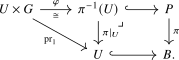
We refer to \(P\) as the total space, to \(G\) as the structure group, and to \(B\) as the base space.
Generated from the authoritative LaTeX source.