Lemma 4.3.6. The functors \((-)_n\colon \PSp (C) \to C_*\) are jointly conservative. In particular, a morphism \(f\colon X \to Y\) of spectra in \(C\) is an isomorphism if and only if each induced map \(f_n\colon X_n \to Y_n\) is an isomorphism.
Proof. Let \(C\) be a stable \(\infty \)-category. If \(I\) is a finite \(\infty \)-category, then \(C\) has \(I\)-indexed colimits by the previous corollary, hence there is a functor \(\colim \colon \Fun (I,C) \to C\). Its domain is also stable and \(\colim \) preserves finite colimits, because colimits commute with colimits. So the functor is exact and hence preserves finite limits as well.
Conversely, assume that \(C\) is finitely complete and cocomplete and that finite limits commute with finite
colimits in \(C\). Considering the empty category, the fact that empty limits commute with empty colimits
expresses that \(C\) is pointed. To show that \(C\) is stable, consider for every \(X \in C\) the following diagram: \begin {equation*} 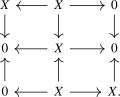
Generated from the authoritative LaTeX source.