Lemma 5.1.13. For every pointed object \(X\), the loop group \(\bOmega X\) is a group object in \(C\).
Proof. To show that \(\bOmega X\) is a monoid, we will show by induction that for every \(n\) the map \[ (e_i^*)_{i=1}^n\colon (\bOmega X)_n \to \prod _{i=1}^n \Omega X \] is an isomorphism in \(C\). For \(n = 0\), observe that \(I_0\) is isomorphic to the walking morphism \([1]\), consisting of objects \(0\) and \(\infty \), and the functor \(f_0\colon I_0 \to C\) is the diagram \(* \to X\). Since \([1]\) has \(0\) as an initial object, this limit is simply \(*\); see Lemma 21.2.4. The case \(n=1\) is the identification from the preceding remark. For \(n \geq 1\), note that we may write \(I_{n+1}\) as a pushout of \(I_n\) and \(I_1\) along \(I_0\):

By applying Theorem 21.2.11(2) with \(J = \,\,\pushout \), we thus obtain a pullback square of the form
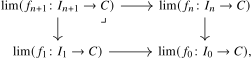
where we take \(f\) to be the basepoint map \(x\colon * \to X\). By induction, this pullback square is isomorphic to the commutative square
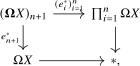
and so this being a pullback square means that the map \((\bOmega X)_{n+1} \xrightarrow {(e_i^*)_{i=1}^{n+1}} \prod _{i=1}^{n+1} \Omega X\) is an isomorphism, finishing the induction step. This shows that \(\bOmega X \) is a monoid in \(C\).
To see that \(\bOmega X\) is grouplike, write \(p_{ij}\colon * \times _X * \times _X * \to * \times _X *\) for the projection retaining the \(i\)-th and \(j\)-th factors. Under the Segal isomorphism \[ (p_{01},p_{12})\colon * \times _X * \times _X * \iso \Omega X \times \Omega X, \] the shear map is identified with \((p_{01},p_{02})\). But associativity of pullbacks gives another isomorphism \[ (p_{01},p_{02})\colon * \times _X * \times _X * \iso (* \times _X *) \times _* (* \times _X *) \cong \Omega X \times \Omega X. \] Thus the shear map is an isomorphism. □
Generated from the authoritative LaTeX source.