Proposition 3.4.5 (Universal approximation). Let \(F\) satisfy the wedge axiom and the Mayer–Vietoris property. For every connected pointed anima \(X\) and every \(\eta \in F(X)\), there are a connected pointed anima \(Z_X\), a pointed map \(f_X\colon X\to Z_X\), and a universal element \(\xi _X\in F(Z_X)\) such that \(f_X^*(\xi _X)=\eta \).
Proof. Step 1: Constructing increasingly universal elements. We construct a sequence \[ X=:Z_0\xrightarrow {f_0}Z_1\xrightarrow {f_1}Z_2\longrightarrow \cdots \] and elements \(\xi _n\in F(Z_n)\) such that \(f_n^*(\xi _{n+1})=\xi _n\), the element \(\xi _n\) is \(n\)-universal for \(n\geq 1\), and \(T_{\xi _n}\) is surjective on \(S^k\) for every \(k\geq 1\).
Set \(\xi _0:=\eta \) and define \[ Z_1:=X\vee \bigvee _{m\geq 1}\ \bigvee _{\gamma \in F(S^m)}S^m. \] By the wedge axiom, there is a unique element \(\xi _1\in F(Z_1)\) whose restriction to \(X\) is \(\eta \) and whose restriction to the sphere indexed by \(\gamma \in F(S^m)\) is \(\gamma \). The inclusion of that sphere shows that \(T_{\xi _1}\) is surjective on \(S^m\) for every \(m\geq 1\). In particular, \(\xi _1\) is \(1\)-universal.
Suppose now that \(n\geq 1\) and that \((Z_n,\xi _n)\) has been constructed. By Remark 3.4.2, the map \[ T_{\xi _n}\colon [S^n,Z_n]_*\longrightarrow F(S^n) \] is a group homomorphism. Let \(K_n\) denote its kernel. Choose a representative \(g\colon S^n\to Z_n\) of every class \([g]\in K_n\), and form the pushout
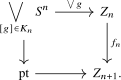
The restrictions of \(\xi _n\) to all the attaching spheres are zero. The Mayer–Vietoris property therefore supplies an element \(\xi _{n+1}\in F(Z_{n+1})\) satisfying \(f_n^*(\xi _{n+1})=\xi _n\).
The map \(T_{\xi _{n+1}}\) remains surjective on every sphere, since \(T_{\xi _n}\) is surjective and \(\xi _n=f_n^*\xi _{n+1}\). Attaching \((n+1)\)-cells induces bijections \[ [S^k,Z_n]_*\xrightarrow {\cong }[S^k,Z_{n+1}]_* \] for \(k<n\), so \(\xi _{n+1}\) remains \(n\)-universal. Finally, every map \(S^n\to Z_{n+1}\) factors up to homotopy through \(Z_n\). If its class lies in the kernel of \(T_{\xi _{n+1}}\), a lift to \(Z_n\) lies in \(K_n\) and hence becomes null-homotopic after the corresponding cell is attached. Thus \(T_{\xi _{n+1}}\) is injective on \(S^n\), proving that \(\xi _{n+1}\) is \((n+1)\)-universal.
Step 2: Passing to the limit. Set \[ Z_X:=\colim _nZ_n. \] The mapping-telescope description from Lemma 2.4.29 gives a pushout square
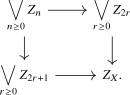
On the summand \(Z_n\), the two maps are the identity and the transition map to the adjacent stage, assigned to the even and odd target wedges according to the parity of \(n\). The relations \(f_n^*(\xi _{n+1})=\xi _n\), together with the wedge axiom and the Mayer–Vietoris property, therefore produce an element \(\xi _X\in F(Z_X)\) restricting to \(\xi _n\) on every stage. In particular, the composite \(f_X\colon X=Z_0\to Z_X\) satisfies \(f_X^*(\xi _X)=\eta \).
For a fixed \(k\geq 1\), the map \(Z_n\to Z_X\) is obtained by attaching cells of dimension at least \(n+1\). Hence Remark 3.3.6 shows that \[ [S^k,Z_n]_*\longrightarrow [S^k,Z_X]_* \] is a bijection once \(n>k\). Since \(\xi _n\) is \(n\)-universal, \(T_{\xi _X}\) is consequently a bijection on \(S^k\). Thus \(\xi _X\) is universal. □
Generated from the authoritative LaTeX source.