Consider morphisms \(f\colon X \to Y\) and \(g\colon Y \to Z\).
If \(g\) is \(n\)-truncated, then \(f\) is \(n\)-truncated if and only if \(gf\) is \(n\)-truncated.
If \(gf\) is \(n\)-truncated and \(g\) is \((n+1)\)-truncated, then \(f\) is \(n\)-truncated.
Proof
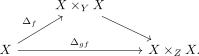
(1) We prove the claim by induction on \(n\). The case \(n = -2\) is clear by 2-out-of-3.For \(n \geq -1\), consider the following commutative triangle: The right diagonal map is a base change of \(\Delta_g\colon Y \to Y \times_Z Y\), hence is \((n-1)\)-truncated. By the induction hypothesis, \(\Delta_f\) is \((n-1)\)-truncated if and only if \(\Delta_{gf}\) is \((n-1)\)-truncated. This completes the proof.(2) We may factor \(f\) as the composite
\[X \xrightarrow{(\id_X,f)} X \times_Z Y \xrightarrow{\pr_Y} Y.\]
The first map is a base change of the \(n\)-truncated map \(\Delta_g\colon Y \to Y \times_Z Y\). The second map is a base change of the \(n\)-truncated map \(gf\colon X \to Z\). By (1) and Lemma 3.5, \(f\) is also \(n\)-truncated.