Let \(C\) be a category with pullbacks and geometric realizations, and assume that groupoid colimits are universal. Then the following three conditions are equivalent:
The category \(C\) satisfies descent for groupoid colimits;
Groupoid colimits are effective in \(C\);
For every groupoid object \(\Gg\) the unit \(\Gg \to \check{C}_{\bullet}(\Gg_0 \to \abs{\Gg})\) of the adjunction from Lemma 2.31 is an isomorphism.
Proof
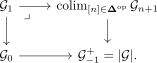
The equivalence between (1) and (2) is Lemma 2.22.From effectivity to the Čech nerve condition. Assume (2), and consider a groupoid object \(\Gg\). By setting \(\Gg^{+}_{-1} := \abs{\Gg} = \colim_{[n] \in \simp\catop} \Gg_n\), we extend \(\Gg\) to an augmented simplicial object \(\Gg^+_{\bullet}\). More precisely, this is the left Kan extension of \(\Gg\) along \(\simp\catop \hookrightarrow \simp\catop_+\). The first face maps define a transformation \(\Gg^+_{\bullet+1} \to \Gg^+_{\bullet}\) whose restriction to \(\simp\catop\) is cartesian by the groupoid condition. Effectivity therefore implies that the extended transformation is cartesian at the cone point. In particular, we obtain a pullback square The top right corner is isomorphic to \(\Gg_0\), since the augmented simplicial object \([n] \mapsto \Gg_{n+1}\) over \(\Gg_0\) admits extra degeneracies. By Lemma 2.20, the augmented object \(\Gg^+_{\bullet}\) is therefore the Čech nerve of \(\Gg_0 \to \abs{\Gg}\), proving (3).From the Čech nerve condition to effectivity. Assume (3). The map \(\Gg_0 \to \abs{\Gg}\) is then an effective epimorphism for every groupoid object \(\Gg\), since its Čech nerve is \(\Gg\) and its geometric realization is \(\abs{\Gg}\).Consider a cartesian transformation \(X_{\bullet} \to Y_{\bullet}\) of groupoid objects, and set \(A:=\abs{X_{\bullet}}\) and \(B:=\abs{Y_{\bullet}}\). We must prove that the canonical map
\[u\colon X_0 \longrightarrow A \times_B Y_0\]
is an isomorphism. The map \(X_0 \to A\) is an effective epimorphism, so pullback along it is conservative by Lemma 2.29. After this base change, the map \(u\) becomes
Condition (3) identifies the source with \(X_1\) and identifies \(Y_1\) with \(Y_0 \times_B Y_0\). Cartesianness of \(X_{\bullet} \to Y_{\bullet}\) then gives
Thus the base change of \(u\) is an isomorphism, and conservativity implies that \(u\) is an isomorphism. This proves effectivity of groupoid colimits.