Let \(\phi^*\colon T \to S\) be a morphism of logoi which preserves dependent products. Then the following conditions are equivalent:
\(\phi^*\) is an étale morphism.
The unit \(\id_S \to \phi^*\phi_{\sharp}\) of the indexed adjunction is cartesian.
\(\phi^*\) provides enough families.
\(\phi^*\) provides enough univalent families.
\(\phi^*\) is object-generating.
If these conditions hold, then \(\phi^*\) is equivalent, under \(T\), to the canonical étale morphism \(T \to T_{/\phi_{\sharp}(*)}\), \(Y\mapsto Y\times \phi_{\sharp}(*)\).
Proof
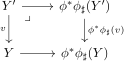
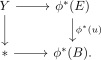
Assume first that \(\phi^*\) is an étale morphism. Choose \(X\in T\) and identify \(S\) with \(T_{/X}\) so that \(\phi^*\) is the functor \(Y\mapsto Y\times X\). Then the left adjoint is the forgetful functor \(T_{/X}\to T\), and the unit is cartesian because a morphism in a slice is recovered by pulling back its total space along the corresponding map to \(X\). This gives (1) \(\Rightarrow\) (2).If the unit is cartesian and \(v\colon Y'\to Y\) is a family in \(S\), then the naturality square exhibits \(v\) as a pullback of the family \(\phi_{\sharp}(v)\) after applying \(\phi^*\). Thus (2) implies (3).Condition (3) implies (5): applying (3) to the family \(Y\to *\) gives a family \(u\colon E\to B\) in \(T\) and a pullback square Since \(* \simeq \phi^*(*)\), the object \(Y\) is a finite limit of objects in the image of \(\phi^*\). Hence \(\phi^*\) is object-generating.Now assume (5). By Lemma 4.55, the morphism \(\phi^*\) factors as an étale morphism followed by a fully faithful morphism \(\psi^*\). Since \(\phi^*\) is object-generating, so is \(\psi^*\). A fully faithful morphism of logoi which is object-generating is an equivalence, because its essential image is already closed under colimits and finite limits. Hence \(\phi^*\) is an étale morphism. This proves (5) \(\Rightarrow\) (1).It remains to compare (3) and (4). The implication (4) \(\Rightarrow\) (3) follows by applying univalent completion from Proposition 4.47 to the target family. Conversely, if (3) holds and \(v\) is univalent in \(S\), choose a family \(u\) in \(T\) and a map \(v\to \phi^*(u)\). Let \(u^{\univ}\) be the univalent completion of \(u\). By Lemma 4.53, \(\phi^*(u^{\univ})\) is univalent, and the composite