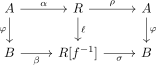
The preceding data define a geometry \(\GZar^{\mathrm{cl}}\).
Proof
Finite limits in \(\GZar^{\mathrm{cl}}\) are finite colimits of finitely presented rings. The topology is generated by admissible covers by definition. Base change of admissible morphisms follows from the formula
for a map \(\varphi\colon R \to S\).For left cancellability, suppose that a principal localization \(R \to R[g^{-1}]\) factors through another principal localization \(R \to R[f^{-1}]\). Then \(f\) is already invertible in \(R[g^{-1}]\), and hence
It follows that the induced map \(R[f^{-1}] \to R[g^{-1}]\) is again a principal localization.It remains to check closure under retracts. Consider a retract diagram in \(\CRing^{\mathrm{fp}}\), where \(\ell\) is localization at \(f\). For every ring \(C\), the restriction map
The latter map is a monomorphism whose image consists of the maps that send \(f\) to a unit. Consequently, restriction along \(\varphi\) is also a monomorphism. If \(a:=\rho(f)\in A\), the retract identities show that a map \(A\to C\) extends across \(\varphi\) if and only if it sends \(a\) to a unit. The universal property of localization therefore gives an isomorphism \(B\cong A[a^{-1}]\) under \(A\).