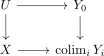
If \(X \in T\) is \(n\)-coherent, then \(\Hom(X,-)\colon T_{\leq n-1} \to \An\) preserves filtered colimits, i.e. the object \(\tau_{n-1}(X) \in T_{\leq n-1}\) is compact.
Proof
Pulling a filtered diagram back to the slice \(T_{/X}\) identifies the required mapping anima with the anima of sections. We may therefore replace \(T\) by \(T_{/X}\) and assume that \(X=*\); the hypothesis becomes the corresponding coherence condition on the terminal object of the slice. We prove the claim by induction on \(n\). For \(n = 0\), the assertion is exactly the definition of quasi-compactness, expressed in terms of filtered unions of subterminal objects.Now consider a filtered category \(I\) and an object \(Y \in \Fun(I, T_{\leq n-1})\). We have to show that the canonical comparison map
is an isomorphism. We will show the following claim:Claim. The map \(\beta_Y\) is an effective epimorphism.Assuming this for a moment, we may conclude. It remains to check that \(\beta_Y\) induces isomorphisms on path animae. Consider two points \(x,y \in \colim_i \Hom(X,Y_i)\). We may represent both at a common stage and, after replacing \(I\) by the corresponding undercategory, assume that this stage is an initial object \(0 \in I\). For each \(i\), let
\[E_i:=X\times_{(x_i,y_i),Y_i\times Y_i}Y_i,\]
where the second map to \(Y_i\times Y_i\) is the diagonal. The anima of sections of \(E_i\to X\) is the path anima from \(x_i\) to \(y_i\). Since \(Y_i\) is \((n-1)\)-truncated, \(E_i\to X\) is \((n-2)\)-truncated. Filtered colimits commute with finite limits in a topos, so the analogous object for \(\colim_iY_i\) is \(\colim_iE_i\). The induction hypothesis in \(T_{/X}\) therefore identifies the two path animae.Let us now prove the claim. Given a map \(X \to \colim_i Y_i\), we need to show that it factors through some finite stage \(Y_i \to \colim_i Y_i\). Since \(X\) is quasi-compact and locally \((n-1)\)-coherent, there is an effective epimorphism \(U \twoheadrightarrow X\) where \(U\) is \((n-1)\)-coherent, satisfying the additional property that the composite \(U \twoheadrightarrow X \to \colim_i Y_i\) factors through some \(Y_0\), where \(0 \in I\). (This uses that \(I\) is filtered.) Letting \(U_{\bullet} := \check{C}_{\bullet}(U \to X)\) and \(V_{i,\bullet} := \check{C}_{\bullet}(Y_0 \to Y_i)\), then the commutative diagram induces a map on Čech nerves of the form
\[U_{\bullet} \to \colim_i V_{i,\bullet}.\]
Since \(U\) is \((n-1)\)-coherent and \(X\) is \(n\)-coherent, each \(U_m\) is \((n-1)\)-coherent.By induction on \(m \leq n\), we show that the map \(\sk_m(U_{\bullet}) \to \colim_i \sk_m(V_{i,\bullet})\) factors through some \(\sk_m(V_{i,\bullet})\), as semisimplicial objects. Here \(\sk_m\) denotes the \(m\)-skeleton. At the successor step, the boundary of the desired \(m\)-simplex has already been chosen at a finite stage. The remaining extension problem is a problem of sections for the pullback of
This map is \((n-m-1)\)-truncated, while \(U_m\) is \((n-1)\)-coherent; the induction hypothesis in the relevant slice therefore moves the extension to a finite stage. Filteredness lets us choose one stage for the finitely many faces and degeneracies. With \(m=n\), we obtain
and since \(\Hom_T(X,Y_i) \cong \Hom_T(\tau_{n-1}(X), Y_i)\) we may conclude.This is the skeletal lifting argument of [Lurie 2018, Proposition A.2.3.1]; the preceding discussion records the coherence and truncation estimates needed in its application here.
References
Jacob Lurie. Spectral Algebraic Geometry. under construction (version dated February 2018), www.math.ias.edu/~lurie/papers/SAG-rootfile.pdf. 2018.