The pair (\(n\)-connected, \(n\)-truncated) forms a factorization system on \(T\).
The \(n\)-connected maps are stable under base change.
A map \(f\colon X \to Y\) is \(n\)-connected if and only if the functor \(f^*\colon (T_{/Y})_{\leq n} \to (T_{/X})_{\leq n}\) is fully faithful.
Proof
(1) We first show that any map \(f\colon X \to Y\) factors as an \(n\)-connected map followed by an \(n\)-truncated map. Let \(X_n := \tau_n(X/Y)\) be the \(n\)-truncation of \(X \in T_{/Y}\). The map \(X_n \to Y\) is \(n\)-truncated by definition.To show that \(X \to X_n\) is \(n\)-connected, consider any \(n\)-truncated morphism \(U \to X_n\). We must show that the map
\[\Hom_{/X_n}(X_n,U) \to \Hom_{/X_n}(X,U)\]
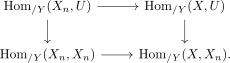
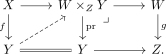
is an equivalence. Since \(T_{/X_n} \simeq (T_{/Y})_{/X_n}\), this map is induced on vertical fibers in the following diagram of Hom animae in \(T_{/Y}\): Since \(U\) and \(X_n\) are \(n\)-truncated objects in \(T_{/Y}\), the universal property of \(X_n = \tau_n(X/Y) \in T_{/Y}\) guarantees that both horizontal maps are equivalences. Thus the induced map on fibers is also an equivalence.Next, we show that any \(n\)-connected map \(f\colon X \to Y\) is left orthogonal to any \(n\)-truncated map \(g\colon W \to Z\). We must show that the anima of diagonal fillers in any commutative square is contractible. Since \(n\)-truncated maps are closed under base change, we may replace \(g\) by the projection \(W \times_Z Y \to Y\). This reduces the problem to finding diagonal fillers in the commutative square: The anima of such diagonal fillers is contractible by \(n\)-connectedness of \(f\). We have therefore constructed the required factorization and proved orthogonality, which are exactly the two conditions in Definition A.2.(2) Consider a pullback square By Corollary 3.10, we have \(\tau_n(X'/Y') \cong g^*\tau_n(X/Y)\). If \(f\) is \(n\)-connected, then \(\tau_n(X/Y) = Y\), so \(\tau_n(X'/Y') = Y'\). Hence \(f'\) is also \(n\)-connected.(3) We need to show that \(f\) is \(n\)-connected if and only if for each two \(n\)-truncated maps \(Z \to Y\) and \(Z' \to Y\), the induced map
\[f^*\colon \Hom_{/Y}(Z,Z') \to \Hom_{/X}(X \times_Y Z, X \times_Y Z')\]
is an equivalence. By the universal property of \(X \times_Y Z'\), the latter is equivalent to the condition that composition with the projection \(X \times_Y Z \to Z\) induces an equivalence
In other words, we have to show that \(f\) is \(n\)-connected if and only if the map \(X \times_Y Z \to Z\) is left orthogonal to every \(n\)-truncated map \(Z' \to Y\). If \(f\) is \(n\)-connected, this follows from parts (1) and (2), since \(X \times_Y Z \to Z\) is a base change of \(f\). Conversely, take \(Z=Y\). The resulting orthogonality condition says that \(f\) is left orthogonal to every \(n\)-truncated map over \(Y\), which is equivalent to \(n\)-connectedness by the characterization above.