A presentable category \(T\) is a topos if and only if \(\Ar^{\pb}(T)\) admits colimits and the inclusion \(\Ar^{\pb}(T) \hookrightarrow \Ar(T)\) preserves colimits.
Proof
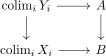
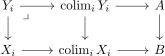
First assume that \(T\) is a topos. We claim that the subcategory \(\Ar^{\pb}(T) \hookrightarrow \Ar(T)\) is closed under colimits. To see this, note that a functor \(I \to \Ar^{\pb}(T)\) corresponds under currying to a cartesian natural transformation \(Y_{\bullet} \to X_{\bullet}\). Passing to colimits in \(T\) extends this to a natural transformation of colimit cocones \(\overline{Y}_{\bullet} \to \overline{X}_{\bullet}\). By effectivity of \(I\)-indexed colimits, this remains a cartesian natural transformation, hence corresponds to a cocone \(I^{\triangleright} \to \Ar^{\pb}(T)\).We must show this is a colimit cocone. In other words, we must show that a commutative square in \(T\) of the form is a pullback square if and only if each of the composite squares is a pullback square. This is an immediate consequence of universality of colimits.For the converse, assume that \(\Ar^{\pb}(T)\) admits colimits and the inclusion preserves them. The fact that colimit cocones in \(\Ar^{\pb}(T)\) agree with colimit cocones in \(\Ar(T)\) immediately implies effectivity of colimits.To prove universality, fix a map \(A\to B\) and a diagram \(X_{\bullet}\) in \(T_{/B}\) with colimit \(X\to B\). The pullback arrows \(A\times_BX_i\to X_i\) form a diagram in \(\Ar^{\pb}(T)\), and the maps to \(A\to B\) form a cocone in \(\Ar^{\pb}(T)\). Its colimit in \(\Ar(T)\) is the arrow
\[\colim_i(A\times_BX_i)\longrightarrow X.\]
Since the inclusion \(\Ar^{\pb}(T)\hookrightarrow\Ar(T)\) preserves this colimit, the induced morphism from this arrow to \(A\to B\) is a pullback square. Consequently,