Example 2.12. (Coproducts)
For a category \(T\) with arbitrary coproducts, we say that coproducts are disjoint if for all \(X, Y \in T\) the diagram

is a pullback square. We claim that arbitrary coproducts in \(T\) are van Kampen if and only if they are universal and \(T\) has disjoint coproducts.
By definition, coproducts are van Kampen if and only if they are universal and for every collection of maps \(\{Y_i \to X_i\}_{i \in I}\) the commutative square
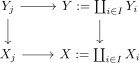
is a pullback square for every \(j \in I\). To see that this reduces to disjointness, consider \(X' := \bigsqcup_{i \in I \setminus \{j\}} X_i\) and \(Y' := \bigsqcup_{i \in I \setminus \{j\}} Y_i\). We may write \(X = X_j \sqcup X'\) and \(Y = Y_j \sqcup Y'\). Invoking universality of coproducts once more shows that the condition reduces to disjointness of binary coproducts.