Corollary 5.100. (Goodwillie's structure theorem)
Consider a functor \(F\colon C \to T\), and define \(G\) via the following pushout square:
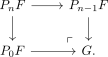
Then the canonical map \(G\to P_0F\) is \(n\)-reduced relative to \(P_0F\), and the square is \(P_n\)-cartesian. Equivalently, applying \(P_n\) turns it into a pullback square.
Proof
The map \(P_nF\to P_{n-1}F\) is a \(P_{n-1}\)-equivalence. Its cobase change \(P_0F\to G\) is therefore a \(P_{n-1}\)-equivalence, and so is the induced map \(G\to P_0F\), by three-for-two. This proves the first assertion.The maps \(P_nF\to P_{n-1}F\) and \(P_nF\to P_0F\) are a \(P_{n-1}\)-equivalence and a \(P_0\)-equivalence, respectively. By Corollary 5.98, the gap map
\[P_nF\longrightarrow P_{n-1}F\times_G P_0F\]
is a \(P_n\)-equivalence. After applying \(P_n\), it becomes an isomorphism, which is precisely the second assertion. This argument is the cartesian part of [Anel et al. 2018, Theorem 3.5.2].References
- Mathieu Anel, Georg Biedermann, Eric Finster, André Joyal. Goodwillie's calculus of functors and higher topos theory. J. Topol., 11 (4), 1100–1132. 2018.