Construction 5.85.
Let \(K \in \Cong(T)\) be a congruence. By Theorem 5.84, congruences form a subalgebra of \(\Acyc(T)\). We can therefore form powers \(K^n\), giving congruences for all \(n \geq 0\) sitting in a chain
We call this the \(K\)-adic filtration. If \(K\) is of small generation, so are its powers, and the filtration gives a tower of quotient logoi
Let \((K^{n+1})^\perp\) denote the right class of the modality determined by \(K^{n+1}\). We define the \((n+1)\)-st layer of the filtration by
For \(X\in T\), let \((K^n/K^{n+1})_X\subseteq T_{/X}\) be the full subcategory spanned by the maps \(Y\to X\) in this class. At the terminal object, it can equivalently be described as the fiber
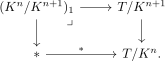
Thus an object of \((K^n/K^{n+1})_1\) is \(K^{n+1}\)-local and becomes terminal after localization at \(K^n\). The same description in the slice \(T_{/X}\) gives the layer at an arbitrary object \(X\).