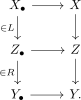
Let \(X_{\bullet},Y_{\bullet} \in \Fun(I,T)\) be two diagrams with colimits \(X\) and \(Y\). If we are given an \(L\)-cartesian transformation \(X_{\bullet} \to Y_{\bullet}\), then the square
is \(L\)-cartesian. Equivalently: the subcategory \(\Ar^{L\text{-}\cart}(T) \subseteq \Ar(T)\) is closed under colimits.
Proof
Let \(P_{\bullet}:=Y_{\bullet}\times_YX\). The transformation \(X_{\bullet}\to P_{\bullet}\) has the same gap maps as \(X_{\bullet}\to Y_{\bullet}\) and is therefore \(L\)-cartesian, while \(P_{\bullet}\to Y_{\bullet}\) is cartesian. Since colimits in a topos are universal, \(\colim P_{\bullet}\iso X\). By Proposition 5.21, it is therefore enough to treat the transformation \(X_{\bullet}\to P_{\bullet}\). Replacing \(Y_{\bullet}\) by \(P_{\bullet}\), we may assume that the induced map \(X\to Y\) on colimits is an isomorphism.Factor the transformation pointwise as
and consider the resulting commutative diagram: By Lemma 5.22, the transformation \(Z_{\bullet} \to Y_{\bullet}\) is cartesian. Descent then implies that the bottom square is a pullback. Since \(L\) is closed under colimits in \(\Ar(T)\), the map \(X \to Z\) lies in \(L\). Its composite \(X\to Z\to Y\) is an isomorphism and hence lies in \(L\), so right cancellation gives \(Z\to Y\in L\). Each map \(Z_i\to Y_i\) is a base change of \(Z\to Y\), because the bottom square is cartesian, and hence also belongs to \(L\). But it belongs to \(R\) by construction, so it is an isomorphism. Thus \(Z_{\bullet}\to Y_{\bullet}\) and \(Z\to Y\) are isomorphisms. Under these identifications, the gap maps \(X_i\to Y_i\times_YX\) are precisely the maps \(X_i\to Z_i\), which lie in \(L\) by construction.