Pointwise limits and colimits in categories of sections
Proposition B.1.
Let \(K\) and \(I\) be categories, let \(F\colon I\to\Cat\), and let \(G\colon I\catop\to\Cat\). Write
\[p\colon \int^{\cc}_I F\longrightarrow I
\qquadtext{and}\qquad
q\colon \int^{\ct}_I G\longrightarrow I\]
for the associated cocartesian and cartesian fibrations, respectively.
Suppose that every \(F(i)\) admits \(K\)-indexed colimits and that every cocartesian transport functor \(\alpha_!\colon F(i)\to F(j)\) preserves them. Then \(\Gamma_I(p)\) admits \(K\)-indexed colimits.
Suppose that every \(F(i)\) admits \(K\)-indexed limits. Then \(\Gamma_I(p)\) admits \(K\)-indexed limits.
Suppose that every \(G(i)\) admits \(K\)-indexed limits and that every cartesian transport functor \(\alpha^*\colon G(j)\to G(i)\) preserves them. Then \(\Gamma_I(q)\) admits \(K\)-indexed limits.
Suppose that every \(G(i)\) admits \(K\)-indexed colimits. Then \(\Gamma_I(q)\) admits \(K\)-indexed colimits.
In every case, the indicated limits or colimits are computed pointwise. In particular, all evaluation functors preserve them.
Proof
We first prove (1). Consider the full subcategory of \(\Cat_{/I}\) spanned by those functors \(u\colon J\to I\) for which the category of sections of \(u^*p\) admits \(K\)-indexed colimits computed pointwise. This subcategory is closed under colimits. Indeed, if \(J\simeq\colim_aJ_a\) in \(\Cat_{/I}\), then
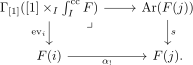
The restriction functors in this limit preserve pointwise colimits, so if all the categories on the right admit \(K\)-indexed colimits computed pointwise, then so does the category on the left.Every category is a colimit of simplices, and each \([n]\) is an iterated pushout of copies of \([1]\) along \([0]\). It therefore suffices to consider maps \([0]\to I\) and \([1]\to I\). The first case is precisely the assumption that each fiber admits \(K\)-indexed colimits. A map \([1]\to I\) classifies a morphism \(\alpha\colon i\to j\). The category of sections of the resulting cocartesian fibration sits in a pullback square The categories in the other three corners admit \(K\)-indexed colimits, the source evaluation \(s\) preserves them, and \(\alpha_!\) preserves them by assumption. Hence the pullback admits \(K\)-indexed colimits computed by the two projections. This proves (1).Statement (4) is [Lurie 2009, Proposition 5.1.2.2], applied to the cartesian fibration \(q\). Passing to opposite categories and using \(K\catop\) as the indexing category gives (2): the functor \(p\catop\colon (\int_I^{\cc}F)\catop\to I\catop\) is a cartesian fibration with fibers \(F(i)\catop\), and
Finally, applying (1), with indexing category \(K\catop\), to the cocartesian fibration \(q\catop\colon (\int_I^{\ct}G)\catop\to I\catop\) proves (3), because the opposite of a cartesian transport functor \(\alpha^*\colon G(j)\to G(i)\) preserves \(K\catop\)-indexed colimits precisely when \(\alpha^*\) preserves \(K\)-indexed limits. The pointwise descriptions in these arguments also show that all evaluation functors preserve the indicated limits or colimits.
References
Jacob Lurie. Higher topos theory. Ann. Math. Stud. 170, Princeton, NJ: Princeton University Press. 2009.