Proposition 5.21. (Properties of \(L\)-cartesian squares)
Consider two composable squares
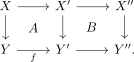
If \(A\) and \(B\) are \(L\)-cartesian, then their composite \(A+B\) is \(L\)-cartesian.
If \(A\) and \(A+B\) are \(L\)-cartesian and \(f\) is an effective epimorphism, then \(B\) is \(L\)-cartesian.
If \(B\) is cartesian and \(A+B\) is \(L\)-cartesian, then \(A\) is \(L\)-cartesian.
Proof
The gap map \(X \to Y \times_{Y''} X''\) of \(A+B\) may be factored as
\[X \to Y \times_{Y'} X' \to Y \times_{Y''} X'',\]
where the first map is the gap map of \(A\) and the second map is the base change along \(Y \to Y'\) of the gap map of \(B\). This immediately implies (1). For (2), it follows from right cancellation that the base change along \(Y \to Y'\) of the gap map of \(B\) lies in \(L\), hence so does the gap map itself by Lemma 5.4.Part (3) is clear: if \(B\) is cartesian, then the gap map of \(A\) agrees with that of \(A+B\).