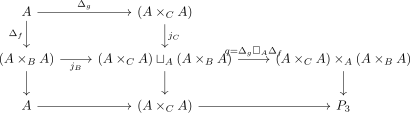
For the zigzag construction associated to the initial span \(B \leftarrow \emptyset \to \emptyset\) over \(B \xleftarrow{f} A \xrightarrow{g} C\), the map \(P_2\to P_3\) is a pushout of \(\Delta_f\square_A\Delta_g\).
Proof
The first step gives
\[Q_1\simeq B, \qquad P_1\simeq A, \qquad R_1\simeq A.\]
The second step makes the right leg cartesian, hence gives
\[R_2\simeq A, \qquad P_2\simeq A\times_C A, \qquad Q_2\simeq (A\times_C A)\sqcup_A B,\]
where the map \(A\to A\times_C A\) is \(\Delta_g\) and \(A\to B\) is \(f\). The third step makes the left leg cartesian, so
\[P_3\simeq Q_2\times_B A \simeq ((A\times_C A)\times_B A)\sqcup_{A\times_B A} A,\]
where we used universality of pushouts. Observe that we may rewrite \((A\times_C A)\times_B A\) as \((A\times_C A)\times_A (A \times_B A)\). Write \(j_C\) and \(j_B\) for the two coprojections into \((A\times_C A)\sqcup_A(A\times_B A)\), and write \(q\) for the canonical map from this pushout to the corresponding product. Consider now the following commutative diagram: The bottom rectangle is the pushout square defining \(P_3\). The upper-left square is the pushout square defining the source of \(q\), and the left rectangle is a pushout by construction. The pasting law therefore shows that the lower-right square is a pushout. Hence \(P_2=A\times_CA\to P_3\) is the cobase change of \(q=\Delta_g\square_A\Delta_f\). By symmetry of the pushout product, this is isomorphic to \(\Delta_f\square_A\Delta_g\), as desired.