Definition 7.2.
A Zariski scheme is a ringed topos \((T,\Oo)\) which is locally isomorphic to \(\Spec(R)_{\Zar}\), i.e. there exists a covering family \(\{U_i \to *\}_{i \in I}\) in \(T\) such that for every \(i \in I\) the induced ringed topos \((T_{/U_i}, \Oo|_{U_i})\) is isomorphic to \(\Spec(R_i)_{\Zar}\) for some ring \(R_i\). A morphism of Zariski schemes \((T,\Oo_T) \to (S,\Oo_S)\) is a pair \((f,f^{\sharp})\) consisting of a morphism of topoi \(f\colon T \to S\) together with a morphism of sheaves of static rings \(f^{\sharp}\colon \Oo_S \to f_*\Oo_T\). We require the adjoint morphism
to be local, meaning that the following square of objects of \(T\) is a pullback:
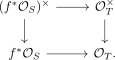
Equivalently, this condition may be tested on sections over every object of \(T\): a section of \(f^*\Oo_S\) is invertible if and only if its image in \(\Oo_T\) is invertible. This gives a category \(\Sch_{\Zar}\).