Theorem 11.3.13 (Atiyah duality). The displayed map exhibits \(\th (-T_M)\) as a dual of \(\S [M]\), and hence determines an isomorphism: \[ D(\S [M])\cong \th (-T_M). \]
Proof. We verify the triangle identities before applying suspension spectra. Each triangle composite is built from twisted collapse maps and a Thom-space pushforward. Transverse base change rewrites it as the composite of a collapse map for a graph embedding and the pushforward along an identity map. Compatibility with composition and isotopy invariance then identify both factors with identity maps.
Observe that the map we wrote is obtained by applying \(\Sigma ^{\infty -N}(-)\colon \Top _* \to \An _* \to \Sp \) to the following composite: \[ \ev \colon M_+ \wedge \Th (\nu ) \xrightarrow {\PT (\Delta , \ul {0} \times \nu )} \Sigma ^N(M_+) \xrightarrow {p_*} \Sigma ^N(S^0) = S^N. \] For the candidate coevaluation map, we similarly apply \(\Sigma ^{\infty - N}(-)\) to the following composite: \[ \coev \colon S^N \xrightarrow {\PT (\phi )} \Th (\nu ) \xrightarrow {\Delta _*} \Th (\nu ) \wedge M_+. \] To see that the triangle identities are satisfied, it is enough to prove corresponding homotopies at the level of topological spaces. More precisely, the triangle identity on \(\th (-T_M)\) is obtained by applying \(\Sigma ^{\infty -2N}\) to the composite \[ S^N \wedge \Th (\nu ) \xrightarrow {\coev \wedge \id } \Th (\nu ) \wedge M_+ \wedge \Th (\nu ) \xrightarrow {\id \wedge \ev } \Th (\nu ) \wedge S^N \] while the triangle identity on \(\S [M]\) is obtained by applying \(\Sigma ^{\infty -N}\) to \[ M_+ \wedge S^N \xrightarrow {\id \wedge \coev } M_+ \wedge \Th (\nu ) \wedge M_+ \xrightarrow {\ev \wedge \id } S^N \wedge M_+ \] Thus it suffices to show that these two composites are homotopic to the respective identities, up to the displayed symmetries of the smash product. We will start with the former. Consider the following pullback square:
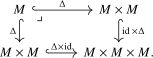
Let us check the transversality hypothesis in this instance. At a point \((x,y)\) of the inverse image of \(\im (\id \times \Delta )\), the image of \(d(\Delta \times \id )\) consists of triples \((v,v,w)\), while the tangent space to \(\im (\id \times \Delta )\) consists of triples \((a,b,b)\). Every triple \((r,s,t)\) decomposes as \[ (r,s,t)=(s,s,t)+(r-s,0,0), \] with the first summand of the former type and the second of the latter type. Thus \(\Delta \times \id \) is transversal to \(\im (\id \times \Delta )\). Applying Proposition 11.3.12 to this square (i.e. we take \(M_2 := M \times M \times M\), \(N_2 := M \times M\), \(i_2 = \id \times \Delta \), \(M_1 := M \times M\), \(N_1 := M\), \(f = \Delta \times \id \) and \(E = \nu \times \ul {0} \times \nu \)) gives the following homotopy-commutative diagram:
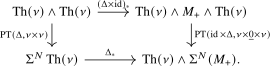
All collapse maps below whose source contains \(S^N_+\) factor through the reduced quotient, since the relevant embeddings lie in \(\R ^N\times M\). We use these reduced maps without further notation. Unwinding the definitions of \(\coev \wedge \id \) and \(\id \wedge \ev \), we then get the following homotopy-commutative diagram. Its top row is the triangle composite, its southeast-pointing arrows are Pontryagin–Thom collapse maps, and its northeast-pointing arrows are Thom-space pushforwards:
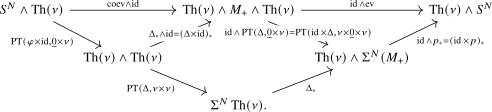
The upper two triangles commute by the definitions of \(\coev \) and \(\ev \), while the central diamond is the transverse base-change square displayed above. By compatibility with composition in Proposition 11.3.12, the left diagonal composite is induced on the reduced quotient by the twisted Pontryagin–Thom collapse map for the composite \[ j\colon M \xhookrightarrow {\Delta } M \times M \xhookrightarrow {\phi \times \id } S^N \times M, \] where we twist by the bundle \(\ul {0} \times \nu \) on \(S^N \times M\). The corresponding unreduced twisted collapse map is \[ \PT (j,\ul {0} \times \nu )\colon S^N_+ \wedge \Th (\nu ) \to \Sigma ^N\Th (\nu ), \] Since the image of \(j\) is contained in \(\R ^N \times M \subseteq S^N \times M\), this map collapses the entire fiber over the point at infinity and therefore factors through the quotient \(S^N_+ \wedge \Th (\nu ) \twoheadrightarrow S^N \wedge \Th (\nu )\). The embedding \(j=(\phi ,\id )\) is isotopic, via the straight-line isotopy in \(\R ^N \subseteq S^N\), to the embedding \((0,\id )\colon M \hookrightarrow \R ^N \times M \subseteq S^N \times M\). By isotopy invariance, the induced map on the reduced quotient is therefore homotopic to the one obtained from \((0,\id )\). Using \(\R ^N \times M\) as a tubular neighborhood for this inclusion, we see that the latter is the identity on \(S^N \wedge \Th (\nu )\).
The right diagonal is the pushforward functoriality of Thom spaces applied to the composite \[ M \xhookrightarrow {\Delta } M \times M \xrightarrow {\id \times p} M \times \pt = M. \] But this composite is simply the identity on \(M\), hence it induces the identity on \(S^N \wedge \Th (\nu )\). We conclude that the composite \((\id \wedge \ev ) \circ (\coev \wedge \id )\) is homotopic to the identity on \(S^N \wedge \Th (\nu )\), proving the first triangle identity.
The second triangle identity follows by the same argument, applied to the transposed pullback square. More precisely, we now take \(i_2 = \Delta \times \id \), \(f = \id \times \Delta \) and use the twist \(E = \ul {0} \times \nu \times \ul {0}\) over \(M \times M \times M\). Transverse base change and compatibility with composition identify the composite \((\ev \wedge \id ) \circ (\id \wedge \coev )\) with the composite of the Pontryagin–Thom collapse map for the graph embedding \[ (\id ,\phi )\colon M \hookrightarrow M \times S^N \] and the Thom-space pushforward induced by \((p \times \id ) \circ \Delta = \id _M\). The graph embedding is isotopic to \((\id ,0)\colon M \hookrightarrow M \times \R ^N\), whose collapse map is the identity on \(M_+ \wedge S^N\) under the standard Thom identifications. Hence the second triangle composite is also homotopic to the identity. □
Generated from the authoritative LaTeX source.