The modern way to interpret duality phenomena is in terms of the notion of dualizable objects in a symmetric monoidal \(\infty \)-category. Throughout this section, we fix a symmetric monoidal \(\infty \)-category \((C,\otimes ,\unit )\).
Definition 11.1.1 (Dualizable object). Consider objects \(X\) and \(Y\) of \(C\). We say that a morphism \(\ev \colon Y \otimes X \to \unit \) exhibits \(Y\) as a dual to \(X\) if there exists another morphism \(\coev \colon \unit \to X \otimes Y\) such that the triangle identities are satisfied: there exist commutative diagrams
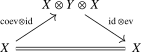
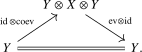
In this case we refer to \(\ev \) as the evaluation map and to \(\coev \) as the coevaluation map, and call \((Y,\ev )\) a duality datum for \(X\). We say that an object \(X\) is dualizable if it admits such a duality datum.
The following result guarantees that the duality datum \((Y,\ev )\) is unique if it exists:
Proposition 11.1.2. Consider objects \(X\) and \(Y\) of \(C\) and consider a morphism \(\ev \colon Y \otimes X \to \unit \) in \(C\). The following conditions are equivalent:
- (1)
-
The morphism \(\ev \colon Y \otimes X \to \unit \) exhibits \(Y\) as a dual to \(X\);
- (2)
-
For all objects \(Z\) and \(W\) of \(C\), the composite \[ \Hom _{C}(W,Z \otimes Y) \xrightarrow {- \otimes X} \Hom _{C}(W \otimes X, Z \otimes Y \otimes X) \xrightarrow {\ev \circ -} \Hom _{C}(W \otimes X, Z) \] is an equivalence.
- (3)
-
The map in (2) is an equivalence for \((W,Z) = (\unit ,X)\) and for \((W,Z) = (Y,\unit )\).
Proof. We first show that (1) implies (2). Let \(\coev \colon \unit \to X \otimes Y\) be the corresponding coevaluation map. It then follows directly from the triangle identities that an inverse to the map in (2) is given by the composite \[ \Hom _{C}(W \otimes X, Z) \xrightarrow {- \otimes Y} \Hom _{C}(W \otimes X \otimes Y, Z \otimes Y) \xrightarrow {- \circ \coev } \Hom _{C}(W,Z \otimes Y). \] It is clear that (2) implies (3). Finally, assume that (3) is satisfied. Taking \(W = \unit \) and \(Z = X\), we get that the composite \[ \Hom _C(\unit ,X \otimes Y) \xrightarrow {- \otimes X} \Hom _C(X, X \otimes Y \otimes X) \xrightarrow {\ev \circ -} \Hom _C(X, X) \] is an equivalence. In particular, there exists a morphism \(\coev \colon \unit \to X \otimes Y\) that is mapped to \(\id _X\) under this equivalence. In particular, the composite \[ X \xrightarrow {\coev \otimes \id } X \otimes Y \otimes X \xrightarrow {\id \otimes \ev } X \] is homotopic to \(\id _X\), showing one of the two triangle identities. To show that the other triangle identity is also satisfied, consider \(W = Y\) and \(Z = \unit \), so that the composite \[ \Hom _C(Y,Y) \xrightarrow {- \otimes X} \Hom _C(Y \otimes X, Y \otimes X) \xrightarrow {\ev \circ -} \Hom _C(Y \otimes X, \unit ) \] is an equivalence. We claim that both the map \(\id _Y\colon Y \to Y\) as well as the composite \(Y \xrightarrow {\id \otimes \coev } Y \otimes X \otimes Y \xrightarrow {\ev \otimes \id } Y\) are sent to \(\ev \colon Y \otimes X \to \unit \) under this equivalence. This is clear for \(\id _Y\). For \((\ev \otimes \id ) \circ (\id \otimes \coev )\) this follows from the following commutative diagram:
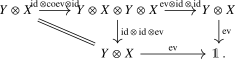
This shows that also the second triangle identity is satisfied, finishing the proof. □
Thus being a duality datum is a property of the evaluation map \(\ev \): once condition (2) holds, the required coevaluation and triangle identities follow. We will use this criterion below to establish duality by constructing and analyzing an evaluation map.
Convention 11.1.3. Let \(X\) be a dualizable object of \(C\). By condition (2) of Proposition 11.1.2, its dual represents the functor \(\Hom _C(-\otimes X,\unit )\colon C\catop \to \An \). In particular, the dual is unique, and we denote it by \(X^{\vee }\). An object representing this functor need not be a dual when \(X\) is not known to be dualizable; see the discussion of weak duals in Subsection 11.1.1.
Definition 11.1.4 (Invertible object). An object \(X\) of \(C\) is called invertible if there exists another object \(X^{-1}\) and an isomorphism \(X \otimes X^{-1} \cong \unit \). Equivalently, \(X\) is invertible if the functor \(X \otimes -\colon C \to C\) is an equivalence.
The full subanima \(\Pic (C) \subseteq C^{\simeq }\) spanned by the invertible objects is called the Picard anima of \(C\).
Proof. Let \(X\) be an invertible object and let \(X^{-1}\) be an inverse with isomorphism \(\ev \colon X^{-1} \otimes X \iso \unit \). We claim that \(\ev \) exhibits \(X^{-1}\) as a dual to \(X\). Using Proposition 11.1.2 we must show that for all objects \(Z\) and \(W\) of \(C\) the composite \[ \Hom _{C}(W,Z \otimes X^{-1}) \xrightarrow {- \otimes X} \Hom _{C}(W \otimes X, Z \otimes X^{-1} \otimes X) \xrightarrow {\ev \circ -} \Hom _{C}(W \otimes X, Z) \] is an equivalence. But both maps are equivalences: the first because the functor \(- \otimes X\colon C \to C\) is an equivalence, and the second because \(\ev \) is an isomorphism. □
Proof. It is invertible, using \(\unit \otimes \unit \cong \unit \). □
Lemma 11.1.7. Symmetric monoidal functors preserve dualizable objects and their duals. Moreover, if \(X,Y\in C\) are dualizable, then \(X\otimes Y\) is dualizable with dual \(X^{\vee }\otimes Y^{\vee }\).
Proof. A symmetric monoidal functor preserves evaluation and coevaluation maps and the triangle identities. For the second claim, apply this observation to the tensor-product functor \(C\times C\to C\), which is symmetric monoidal for the componentwise tensor product on \(C\times C\), and to the dualizable object \((X,Y)\). □
11.1.1 Internal homs
The notion of duality is closely related to that of internal homs. Internal homs provide a candidate \(D(X)\) for the dual of every object; dualizability is the additional condition that tensoring with this weak dual actually represents mapping out of \(X\). This perspective will allow us to prove that dualizable objects form a thick subcategory.
Definition 11.1.8. Given two objects \(X,Z \in C\), an object \(\iHom (X,Z) \in C\) equipped with a map \(\ev \colon \iHom (X,Z) \otimes X \to Z\) is said to exhibit \(\iHom (X,Z)\) as an internal hom from \(X\) to \(Z\) if for every third object \(W\) the composite \[ \Hom _{C}(W,\iHom (X,Z)) \xrightarrow {- \otimes X} \Hom _{C}(W \otimes X, \iHom (X,Z) \otimes X) \xrightarrow {\ev \circ -} \Hom _{C}(W \otimes X, Z) \] is an equivalence.
Remark 11.1.9. Internal homs are unique if they exist. When they exist for every \(Z\), the assignment \(Z\mapsto \iHom (X,Z)\) defines a right adjoint to \(-\otimes X\colon C\to C\). A symmetric monoidal \(\infty \)-category admitting all internal homs is also called closed.
Lemma 11.1.10. Assume that \(C\) admits internal homs. Then for every object \(X \in C\), the adjunction between \(- \otimes X\) and \(\iHom (X,-)\) gives a currying isomorphism: for \(Y,Z \in C\) there is a natural equivalence \begin {align*} \iHom (X\otimes Y, Z) \simeq \iHom (X, \iHom (Y,Z)). \end {align*}
Proof. This follows from the Yoneda lemma, and the observation that for every fourth object \(W \in C\) there are natural equivalences \begin {align*} \Hom _{C}(W,\iHom (X\otimes Y, Z)) &\simeq \Hom _{C}(W \otimes X \otimes Y, Z) \\ &\simeq \Hom _{C}(W \otimes X, \iHom (Y,Z)) \\ &\simeq \Hom _{C}(W,\iHom (X, \iHom (Y,Z))). \qedhere \end {align*} □
We now provide a formulation of duality in terms of internal homs.
Lemma 11.1.11. Let \(X\) and \(Y\) be objects and let \(\ev \colon Y \otimes X \to \unit \) be a morphism in \(C\). Then the following conditions are equivalent:
- (1)
-
The morphism \(\ev \) exhibits \(Y\) as a dual to \(X\).
- (2)
-
For every object \(Z\) of \(C\), the morphism \(\id _Z \otimes \ev \colon Z \otimes Y \otimes X \to Z\) exhibits \(Z \otimes Y\) as an internal hom \(\iHom (X,Z)\).
- (3)
-
The functor \(X \otimes -\colon C \to C\) admits a right adjoint \(\iHom (X,-)\colon C \to C\), and for every object \(Z\) of \(C\) the map \[ Z \otimes Y \to \iHom (X,Z) \] induced by the morphism \(\id \otimes \ev \colon Z \otimes Y \otimes X \to Z\) is an isomorphism in \(C\).
Proof. The equivalence between (1) and (2) is a reformulation of Proposition 11.1.2. The equivalence between (2) and (3) is clear. □
There is often an a priori candidate for the dual of \(X\), sometimes called the weak dual:
Definition 11.1.12. Assume that \(C\) admits internal homs. We define the internal duality functor \(D\colon C\catop \to C\) as \begin {align*} D(-) := \iHom (-,\unit )\colon C\catop \to C. \end {align*}
If \(X\) is dualizable, the evaluation map \(\ev \colon X^{\vee } \otimes X \to \unit \) induces an isomorphism \(X^{\vee } \iso \iHom (X,\unit ) = D(X)\).
Corollary 11.1.13. Let \(X\) be an object of \(C\) for which the internal hom functor \(\iHom (X,-)\colon C \to C\) exists. Then \(X\) is dualizable if and only if for every \(Z \in C\) the natural map \(Z \otimes D(X) \to \iHom (X,Z)\) adjoint to the composite \(Z \otimes D(X) \otimes X \xrightarrow {Z \otimes \ev } Z \otimes \unit \simeq Z\) is an equivalence.
Remark 11.1.14. The objects called dualizable here are called strongly dualizable in Lewis et al. (1986), Chapter III, Definition 1.1. That reference also gives the following useful criterion: if \(C\) is closed, then \(X\) is dualizable precisely when the morphism \(\unit \to \iHom (X,X)\) adjoint to \(\id _X\) factors through the natural map \(X\otimes D(X)\to \iHom (X,X)\).
Definition 11.1.15. A stably symmetric monoidal \(\infty \)-category is a symmetric monoidal \(\infty \)-category \(C\) which is stable and whose tensor product \(- \otimes - \colon C \times C \to C\) is exact in both variables.
Lemma 11.1.16. Let \(C\) be a stably symmetric monoidal \(\infty \)-category which admits internal homs. Then the collection of dualizable objects forms a thick subcategory of \(C\), i.e. it is a stable subcategory closed under retracts.
Proof. By Corollary 11.1.13, an object \(X\) is dualizable if and only if the natural map \[ Z \otimes D(X) \to \iHom (X,Z) \] is an equivalence for every \(Z \in C\). Since both sides are exact functors in \(X\), it follows that the collection of objects \(X\) for which it is an equivalence forms a stable subcategory of \(C\). It is also closed under retracts since equivalences in \(C\) are closed under retracts. □
Generated from the authoritative LaTeX source.