Proposition 11.1.2. Consider objects \(X\) and \(Y\) of \(C\) and consider a morphism \(\ev \colon Y \otimes X \to \unit \) in \(C\). The following conditions are equivalent:
- (1)
-
The morphism \(\ev \colon Y \otimes X \to \unit \) exhibits \(Y\) as a dual to \(X\);
- (2)
-
For all objects \(Z\) and \(W\) of \(C\), the composite \[ \Hom _{C}(W,Z \otimes Y) \xrightarrow {- \otimes X} \Hom _{C}(W \otimes X, Z \otimes Y \otimes X) \xrightarrow {\ev \circ -} \Hom _{C}(W \otimes X, Z) \] is an equivalence.
- (3)
-
The map in (2) is an equivalence for \((W,Z) = (\unit ,X)\) and for \((W,Z) = (Y,\unit )\).
Proof. We first show that (1) implies (2). Let \(\coev \colon \unit \to X \otimes Y\) be the corresponding coevaluation map. It then follows directly from the triangle identities that an inverse to the map in (2) is given by the composite \[ \Hom _{C}(W \otimes X, Z) \xrightarrow {- \otimes Y} \Hom _{C}(W \otimes X \otimes Y, Z \otimes Y) \xrightarrow {- \circ \coev } \Hom _{C}(W,Z \otimes Y). \] It is clear that (2) implies (3). Finally, assume that (3) is satisfied. Taking \(W = \unit \) and \(Z = X\), we get that the composite \[ \Hom _C(\unit ,X \otimes Y) \xrightarrow {- \otimes X} \Hom _C(X, X \otimes Y \otimes X) \xrightarrow {\ev \circ -} \Hom _C(X, X) \] is an equivalence. In particular, there exists a morphism \(\coev \colon \unit \to X \otimes Y\) that is mapped to \(\id _X\) under this equivalence. In particular, the composite \[ X \xrightarrow {\coev \otimes \id } X \otimes Y \otimes X \xrightarrow {\id \otimes \ev } X \] is homotopic to \(\id _X\), showing one of the two triangle identities. To show that the other triangle identity is also satisfied, consider \(W = Y\) and \(Z = \unit \), so that the composite \[ \Hom _C(Y,Y) \xrightarrow {- \otimes X} \Hom _C(Y \otimes X, Y \otimes X) \xrightarrow {\ev \circ -} \Hom _C(Y \otimes X, \unit ) \] is an equivalence. We claim that both the map \(\id _Y\colon Y \to Y\) as well as the composite \(Y \xrightarrow {\id \otimes \coev } Y \otimes X \otimes Y \xrightarrow {\ev \otimes \id } Y\) are sent to \(\ev \colon Y \otimes X \to \unit \) under this equivalence. This is clear for \(\id _Y\). For \((\ev \otimes \id ) \circ (\id \otimes \coev )\) this follows from the following commutative diagram:
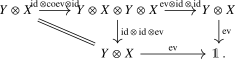
This shows that also the second triangle identity is satisfied, finishing the proof. □
Generated from the authoritative LaTeX source.