We now prove Proposition 10.2.11. This section supplies the coherence behind the construction and may be skipped without interrupting the subsequent applications.
Let us first describe the strategy. For every topological space \(X\), fiberwise one-point compactification gives a symmetric monoidal functor from vector bundles over \(X\) to pointed bundles over \(X\). Passing to fundamental animae gives a lax symmetric monoidal functor \[ \xi _X\colon \Vect _{\R }^{\disc }(X)^{\simeq } \longrightarrow \Fun (\Pi _{\infty }(X),\An _*), \qquad E\longmapsto \big (x\longmapsto \Pi _{\infty }(S^{E_x})\big ), \] and the structure maps of this functor are pointwise isomorphisms. This only gives a construction on the discrete groupoid of vector bundles, so it does not yet encode the topology on the spaces of bundle isomorphisms. To retain that topology, we apply the construction to \(X\times \abs {\Delta ^q}\) in every simplicial degree. The projection \(X\times \abs {\Delta ^q}\to X\) induces an isomorphism on fundamental animae, so left Kan extension transports the resulting family back to \(\Pi _{\infty }(X)\). These functors form a cocone on the simplicial diagram defining \(\Vect _{\R }(X)^{\simeq }\), and hence descend to the desired functor. Carrying out the construction naturally in \(X\) supplies all the required coherence.
For this coherent construction we need two consequences of the pointed-object formalism developed in Part II. We record them here because their only use is the present application. Their proofs assume reasonable familiarity with the operadic material of Part II and may be treated as black boxes on a first reading.
Lemma 10.5.1 (Pointed realization). Every finite-product-preserving functor \(F\colon C\to D\) between \(\infty \)-categories with finite products induces a canonical morphism of pointed \(\infty \)-operads \[ F_*\colon (\Mm _{(C,\times )})_* \longrightarrow (\Mm _{(D,\times )})_*, \] whose color functor sends \((*\to X)\) to \((*\to F(X))\). If \(D\) admits finite colimits and its cartesian product preserves them separately in both variables, then its target is naturally equivalent to \(\Mm _{(D_*,\wedge )}\).
Proof. By Proposition 15.3.6, the functor \(F\) has a unique symmetric monoidal refinement for the cartesian monoidal structures. Applying the pointed-object construction \((-)_*\colon \Op _{\infty }^*\to \Op _{\infty }^{\pt }\) of Theorem 18.4.12 gives the asserted morphism. The identification of the target with the smash-product operad is Lemma 18.4.10. □
Lemma 10.5.2 (Pointwise smash products). For every anima \(B\), pointed straightening is a symmetric monoidal equivalence \[ \Fun (B,\An _*)\simeq (\An _{/B})_*, \] where the source carries the pointwise smash product and the target carries the smash product induced from the cartesian monoidal structure on \(\An _{/B}\).
Proof. The equivalence \[ \Ar (\Fun (B,\An )) \simeq \Fun (B,\Ar (\An )) \] identifies pushout products and cofibers on the left with their pointwise counterparts on the right. The symmetric monoidal localization of Lemma 16.3.4 therefore upgrades the canonical equivalence \(\Fun (B,\An )_*\simeq \Fun (B,\An _*)\) to a symmetric monoidal equivalence, where the right-hand side carries the pointwise smash product. Unpointed straightening \(\Fun (B,\An )\simeq \An _{/B}\) preserves finite products, since pointwise products correspond to fiber products over \(B\). Applying Lemma 10.5.1 finishes the proof. □
These lemmas keep the point-set topology and the higher coherence separate: point-set topology enters through fiberwise one-point compactification, while pointed realization and straightening supply the coherent lax symmetric monoidal structure after passage to animae.
Fix a topological space \(X\). Let \(\mathrm {Bun}(X)\) be the 1-category of locally trivial fiber bundles over \(X\) and continuous maps over \(X\). Its terminal object is the identity bundle \(X\to X\), and its finite products are fiber products over \(X\). Let \(\mathrm {Bun}_{*,\mathrm {c}}(X)\) be the 1-category of fiber bundles over \(X\) with compact Hausdorff pointed fibers and pointed bundle maps. Its symmetric monoidal structure is the fiberwise smash product, and we refer to the distinguished section of such a bundle as its section at infinity.
Lemma 10.5.3 (Fiberwise one-point compactification). Fiberwise one-point compactification defines a symmetric monoidal functor \[ \Vect _{\R }^{\disc }(X)^{\simeq } \longrightarrow \mathrm {Bun}_{*,\mathrm {c}}(X)^{\simeq }, \qquad E\longmapsto (X\xrightarrow {s_{\infty }}S^E\to X). \]
Proof. The total-space functor from vector bundles over \(X\) to fiber bundles over \(X\) preserves finite products: the total space of \(E\oplus F\) is \(E\times _XF\). Fiberwise one-point compactification carries this product to the fiberwise smash product. More precisely, removal of the section at infinity gives a natural isomorphism \[ (K\wedge _XL)\setminus \{\infty \} \cong (K\setminus \{\infty \})\times _X (L\setminus \{\infty \}). \] Fiberwise one-point compactification and removal of the section at infinity are inverse equivalences between the groupoid of bundles with locally compact Hausdorff fibers and the groupoid \(\mathrm {Bun}_{*,\mathrm {c}}(X)^{\simeq }\). Since removal of the section is fully faithful, the displayed identification is compatible with the associativity, unit, and symmetry constraints. This proves the claim. □
We next pass from pointed bundles to families of pointed animae. Taking fundamental animae of total spaces defines a functor \[ \Pi _{\infty ,X}\colon \mathrm {Bun}(X) \longrightarrow \An _{/\Pi _{\infty }(X)}. \]
Lemma 10.5.4 (Parametrized realization). The functor \(\Pi _{\infty ,X}\) preserves finite products. On pointed compact bundles it induces a canonical lax symmetric monoidal functor \[ \Pi _{\infty ,X,*}\colon \big (\mathrm {Bun}_{*,\mathrm {c}}(X),\wedge _X\big ) \longrightarrow \big ((\An _{/\Pi _{\infty }(X)})_*,\wedge _{\Pi _{\infty }(X)}\big ). \]
Proof. The terminal bundle is sent to the terminal object \(\Pi _{\infty }(X)\to \Pi _{\infty }(X)\). If \(E\to X\) and \(F\to X\) are fiber bundles, their product is \(E\times _XF\to X\). Since every fiber bundle is a Serre fibration by Theorem 2.3.13, we obtain from Proposition 2.3.19 a natural isomorphism \[ \Pi _{\infty }(E\times _XF) \cong \Pi _{\infty }(E) \times _{\Pi _{\infty }(X)} \Pi _{\infty }(F). \] Thus \(\Pi _{\infty ,X}\) preserves finite products. Straightening identifies \(\An _{/\Pi _{\infty }(X)}\) with \(\Fun (\Pi _{\infty }(X),\An )\), so it has finite colimits and its cartesian product preserves them separately in both variables. The lax symmetric monoidal refinement on pointed objects is therefore supplied by Lemma 10.5.1. On compact pointed bundles, the tensor operations in this pointed construction are represented by fiberwise smash products: a bundle map \(\prod _{i=1}^rK_i\to L\) which sends the union on which some coordinate is the section at infinity to the section at infinity factors uniquely through a pointed bundle map \[ K_1\wedge _X\dots \wedge _XK_r\longrightarrow L. \] Restricting pointed realization to these bundles therefore gives the asserted lax symmetric monoidal functor. □
Pointed straightening is a symmetric monoidal equivalence \[ \big ((\An _{/\Pi _{\infty }(X)})_*,\wedge _{\Pi _{\infty }(X)}\big ) \simeq \Fun (\Pi _{\infty }(X),\An _*) \] by Lemma 10.5.2. Composing this equivalence with the functors of Lemma 10.5.3, Lemma 10.5.4 gives the promised lax symmetric monoidal functor \[ \xi _X\colon \Vect _{\R }^{\disc }(X)^{\simeq } \longrightarrow \Fun (\Pi _{\infty }(X),\An _*), \qquad E\longmapsto \xi _E. \] At this stage no preservation of pushouts by \(\Pi _{\infty ,X}\) has been asserted or used. The lax structure is supplied by pointed realization; we now check pointwise that its structure maps are isomorphisms on sphere bundles.
Proof. It is enough to show that its unit and binary lax structure maps are isomorphisms. Isomorphisms in \(\Fun (\Pi _{\infty }(X),\An _*)\) are detected pointwise. For a point \(x\in X\), the bundle projections are Serre fibrations, so taking the fiber of the pointed object associated with \(S^E\to X\) gives the pointed anima \(\Pi _{\infty }(S^{E_x})\). The fiber at \(x\) of the binary lax structure map is therefore the canonical map \[ \Pi _{\infty }(S^{E_x})\wedge \Pi _{\infty }(S^{F_x}) \longrightarrow \Pi _{\infty }(S^{E_x}\wedge S^{F_x}) \cong \Pi _{\infty }(S^{E_x\oplus F_x}). \] The pointed spheres are cell complexes and their basepoints are NDR inclusions. Hence Corollary 2.3.20, Proposition 2.3.10, Corollary 2.3.11 identify the first map as an isomorphism. The unit comparison is the corresponding isomorphism \[ S^0\cong \Pi _{\infty }(S^0). \] Thus the unit and binary structure maps of the already constructed lax symmetric monoidal functor are isomorphisms, so the functor is symmetric monoidal. □
Lemma 10.5.6 (Naturality in the base). The symmetric monoidal functors \(\xi _X\) assemble into a natural transformation \[ \xi \colon \Vect _{\R }^{\disc }(-)^{\simeq } \Longrightarrow \Fun (\Pi _{\infty }(-),\An _*) \] between functors \(\Top \catop \to \CMon (\Cat _{\infty })\), where the functor categories on the right carry their pointwise symmetric monoidal structures.
Proof. The assignments \(X\mapsto \Vect _{\R }^{\disc }(X)^{\simeq }\) and \(X\mapsto \mathrm {Bun}(X)\) are classified by cartesian fibrations over \(\Top \), whose cartesian morphisms are the pullback squares of vector bundles and fiber bundles, respectively. The total-space functor and fiberwise one-point compactification preserve cartesian morphisms.
Taking fundamental animae of the horizontal and vertical maps gives a functor from the cartesian fibration of fiber bundles to the codomain cartesian fibration \[ \Ar (\An )\longrightarrow \An . \] It preserves cartesian morphisms: for a continuous map \(f\colon Y\to X\) and a fiber bundle \(E\to X\), the defining pullback square for \(f^*E\) is sent by \(\Pi _{\infty }\) to a pullback square, since \(E\to X\) is a Serre fibration. After cartesian straightening, pointed realization, and pointed straightening, these cartesian functors therefore give the asserted natural transformation. The constructions preserve the fiberwise symmetric monoidal structures, so this is a natural transformation of functors valued in \(\CMon (\Cat _{\infty })\). □
Lemma 10.5.7 (Transport along simplicial thickenings). Let \(X\) be a topological space and let \[ p_{X,q}\colon \Pi _{\infty }(X\times \abs {\Delta ^q}) \longrightarrow \Pi _{\infty }(X) \] be induced by the projection. Left Kan extension along \(p_{X,q}\) gives symmetric monoidal functors \[ \Phi _{X,q}:= (p_{X,q})_!\circ \xi _{X\times \abs {\Delta ^q}}\colon \Vect _{\R }^{\disc }(X\times \abs {\Delta ^q})^{\simeq } \longrightarrow \Fun (\Pi _{\infty }(X),\An _*). \] As \([q]\) varies, these functors form a cocone on the simplicial diagram defining \(\Vect _{\R }(X)^{\simeq }\). This cocone is natural in \(X\).
Proof. The projection \(X\times \abs {\Delta ^q}\to X\) is a homotopy equivalence, so \(p_{X,q}\) is an isomorphism of animae. Consequently, restriction along \(p_{X,q}\) is a symmetric monoidal equivalence \[ p_{X,q}^*\colon \Fun (\Pi _{\infty }(X),\An _*) \longrightarrow \Fun (\Pi _{\infty }(X\times \abs {\Delta ^q}),\An _*). \] Its inverse \((p_{X,q})_!\) inherits the unique symmetric monoidal structure of an inverse equivalence. It follows that \(\Phi _{X,q}\) is symmetric monoidal.
A morphism \(\alpha \colon [m]\to [q]\) in \(\simp \) induces a commutative square
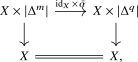
where \(\bar \alpha \) is the corresponding affine map. All three induced maps of fundamental animae in this square are isomorphisms. The natural transformation of Lemma 10.5.6, together with functoriality of the inverse equivalences given by left Kan extension, therefore gives a symmetric monoidal natural isomorphism \[ \Phi _{X,m}\circ (\id _X\times \bar \alpha )^* \cong \Phi _{X,q}. \] These isomorphisms are compatible with composition because both the naturality of \(\xi \) and left Kan extension are functorial. They therefore define the asserted cocone. For a continuous map \(f\colon Y\to X\), the analogous commutative square has the projections to \(Y\) and \(X\) as its vertical maps. Since these induce isomorphisms of fundamental animae, the same argument gives a symmetric monoidal natural isomorphism \[ \Phi _{Y,q}\circ (f\times \id _{\abs {\Delta ^q}})^* \cong (\Pi _{\infty }f)^*\circ \Phi _{X,q}. \] The coherence of these isomorphisms under composition follows from the same functoriality, proving that the cocone is natural in \(X\). □
Proof of Proposition 10.2.11. Fix a topological space \(X\). Since every morphism in the source of \(\Phi _{X,q}\) is a bundle isomorphism, the cocone of Lemma 10.5.7 factors through the groupoid core of \(\Fun (\Pi _{\infty }(X),\An _*)\). By the defining colimit of Definition 10.2.10, it therefore induces a symmetric monoidal functor \[ S_X^{(-)}\colon \Vect _{\R }(X)^{\simeq } \longrightarrow \Fun (\Pi _{\infty }(X),\An _*) \simeq (\An _{/\Pi _{\infty }(X)})_*. \] In simplicial degree zero, this functor sends a vector bundle \(E\to X\) to the spherical fibration \(\xi _E\). The naturality in \(X\) asserted in the proposition follows from the naturality of the cocones in Lemma 10.5.7.
It remains to identify the rank components and the restriction of \(S_{\pt }^{(-)}\). Real vector bundles over a simplex are trivial, and the automorphisms of the trivial rank \(n\) bundle form the singular simplicial group of \(\GL _n(\R )\). Its realization is \(\bB \GL _n(\R )\). Polar decomposition gives a homotopy equivalence \(O(n)\hookrightarrow \GL _n(\R )\), and hence an isomorphism \[ \bB O(n)\cong \bB \GL _n(\R ). \] Thus the rank \(n\) component of \(\Vect _{\R }(\pt )^{\simeq }\) is \(\bB O(n)\). The construction sends a linear isomorphism to its extension over one-point compactifications, so its restriction to this component classifies the standard pointed action of \(O(n)\) on \(S^{\R ^n}\). The block-sum maps give compatibility with the commutative-monoid structures. □
Exercises
Exercise 10.1 (External sums and Thom spectra). Let \(V\colon A\to \BOP \) and \(W\colon B\to \BOP \) be virtual vector bundles. Define their external sum as the composite \[ V\boxplus W\colon A\times B\xrightarrow {V\times W}\BOP \times \BOP \xrightarrow {+}\BOP . \] Show that there is a natural isomorphism \[ \th (V\boxplus W)\cong \th (V)\otimes \th (W). \]
Exercise 10.2 (The Möbius bundle). Let \(L\to S^1\) be the Möbius real line bundle.
- (1)
-
Identify \(\Th (L)\) with \(\R \!\mathrm {P}^2\) as a pointed space.
- (2)
-
Show that \(L\) is not \(H\Z \)-orientable.
- (3)
-
Construct its canonical \(H\F _2\)-orientation. Writing \(a\in H^1(\R \!\mathrm {P}^2;\F _2)\) for the standard generator, show that the Thom class is \(a\) and that the Thom isomorphism sends the generators of \(H^0(S^1;\F _2)\) and \(H^1(S^1;\F _2)\) to \(a\) and \(a^2\), respectively.
Exercise 10.3 (Collapse of a framed point). Embed a point in \(\R ^n\) and equip its normal bundle with the standard framing. Write down the Pontryagin–Thom collapse map \[ S^n\longrightarrow \Th (\R ^n)\cong S^n. \] Show that, with the standard choices of orientation, this map has degree \(1\). Explain how reversing one vector in the framing changes the degree.
Generated from the authoritative LaTeX source.