Definition 1.7.5 (Cocone \(\infty \)-categories). For an \(\infty \)-category \(I\), we define the \(\infty \)-category \(I^{\triangleright }\), called the cocone of \(I\), via the following pushout square of \(\infty \)-categories:
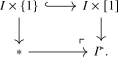
We will often denote the object classified by the bottom morphism as \(\infty \). Note that a functor \(\overline {F}\colon I^{\triangleright } \to C\) consists of a functor \(I \times [1] \to C\) whose restriction to \(I \times \{1\}\) is constant. Equivalently, it consists of a functor \(F := \overline {F}\vert _{I \times \{0\}}\colon I \to C\) and an object \(W := \overline {F}(\infty )\) in \(C\) together with a cocone \(F \to \const _W\).
We say that a functor \(\overline {F}\colon I^{\triangleright } \to C\) is a colimit diagram if the associated cocone \(F \to \const _W\) is a colimit cocone.
We dually define \(I^{\triangleleft }\), called the cone of \(I\), as the following pushout of \(\infty \)-categories:
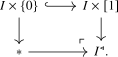
A functor \(\overline {F} \colon I^{\triangleleft } \to C\) consists of a functor \(F\colon I \to C\) together with a cone \(\const _W \to F\). We say that \(\overline {F}\) is a limit diagram if this cone is a limit cone.
Generated from the authoritative LaTeX source.