Opposite categories, subcategories, and localizations modify an \(\infty \)-category by reversing its morphisms, restricting its objects or morphisms, or formally inverting a chosen class of morphisms. This section develops these three constructions.
1.5.1 Opposite categories
Axiom G. For every \(\infty \)-category \(C\) there is an opposite category \(C\catop \). Similarly every functor \(F\colon C \to D\) induces an opposite functor \(F\catop \colon C\catop \to D\catop \), and this process respects composition of functors. We have equivalences \((C\catop )\catop \simeq C\) and \((F\catop )\catop \simeq F\).
If \(C\) and \(D\) come from classical 1-categories then \(C\catop \) and \(F\catop \) agree with the usual constructions of opposite categories.
If \(X\) is an anima then we have an equivalence \(X\catop \simeq X\).
Note that functors \([1] \to C\catop \) correspond to functors \([1] \simeq [1]\catop \to (C\catop )\catop \simeq C\), so that morphisms in \(C\catop \) are just morphisms in \(C\) but with source and target flipped. Also since \([2] \simeq [2]\catop \), this correspondence between morphisms in \(C\) and morphisms in \(C\catop \) preserves composition. In particular \(C\) is an anima if and only if \(C\catop \) is an anima.
Proposition 1.5.1. The construction \(C \mapsto C\catop \) is compatible with all constructions of \(\infty \)-categories:
- (1)
-
There are equivalences \(*\catop \simeq *\) and \(\emptyset \catop \simeq \emptyset \).
- (2)
-
For \(\infty \)-categories \(C\) and \(D\) there are equivalences \begin {align*} (C \times D)\catop &\simeq C\catop \times D\catop , \\ C\catop \sqcup D\catop &\simeq (C \sqcup D)\catop , \\ \Fun (C\catop ,D\catop ) &\simeq \Fun (C,D)\catop . \end {align*}
- (3)
-
For functors \(F\colon C \to E\) and \(G\colon D \to E\) there is an equivalence \[ (C \times _E D)\catop \simeq C\catop \times _{E\catop } D\catop . \]
- (4)
-
For an \(\infty \)-category \(C\) there is an equivalence \((C\catop )^{\simeq } \simeq (C^\simeq )\catop \).
Proof. All of these properties follow readily from the universal properties of these constructions. For illustration, let us merely sketch the proof that \((-)\catop \) preserves products: functors \(T \to (C\times D)\catop \) correspond to functors \(T\catop \to C \times D\), which in turn are pairs of functors \((T\catop \to C, T\catop \to D)\), which in turn translate back into pairs of functors \((T \to C\catop , T \to D\catop )\), i.e. functors \(T \to C\catop \times D\catop \). □
Exercise 1.5.2. Let \(x\) and \(y\) be objects of an \(\infty \)-category \(C\). Show that there is an equivalence \[ \Hom _{C\catop }(x,y) \simeq \Hom _C(y,x). \] Hint: apply \((-)\catop \) to the pullback square defining \(\Hom _C(y,x)\) and use that \(\Hom _C(y,x)\) is an anima.
1.5.2 Subcategories
Next, we would like to define the notion of subcategories. Just like in classical category theory, a subcategory of an \(\infty \)-category \(C\) is determined by choosing some objects of \(C\) and some morphisms between them, subject to closure under identities and composition. However, while the subcategory can be constructed ‘by hand’ in the classical situation, we must now make sure that all the higher coherence data from \(C\) is inherited by the subcategory. In order to formulate this, we start by isolating the homotopical analogue of a subcategory inclusion.
Definition 1.5.3. A functor \(F\colon C \to D\) is called a monomorphism if the commutative square

is a pullback square, i.e. the functor \(\Delta _F := (\id _C,\id _C)\colon C \to C \times _D C\) is an equivalence of \(\infty \)-categories.
Remark 1.5.4. Note that this means that two functors \(G,H\colon T \to C\) are naturally isomorphic whenever the functors \(F\circ G\) and \(F \circ H\) are naturally isomorphic, reflecting the usual categorical notion of monomorphism.
We may sometimes write \(F\colon C \hookrightarrow D\) if \(F\) is a monomorphism. If \(y\) is an object of \(D\), we say that \(y\) is contained in \(C\), sometimes written as \(y \in C\), if there exists some object \(x\) of \(C\) satisfying \(F(x) \cong y\).
Exercise 1.5.5. Let \(F\colon C \hookrightarrow D\) be a monomorphism, and let \(y\) be an object of \(D\) which is contained in \(C\). Show that the fiber \(C_y\) of \(F\) at \(y\) is contractible.
Hint: Show that any functor \(x\colon * \to C_y\) is an equivalence by exhibiting it as a pullback of the equivalence \(\Delta _F\colon C \to C \times _D C\).
The projection from the \(\infty \)-category of isomorphisms introduced in Definition 1.4.21 is the principal example needed below.
Proposition 1.5.6 (Isomorphisms form a subcategory of arrows). For every \(\infty \)-category \(C\), the functor \[ \pi _{\Iso }\colon \Iso (C) \to \Ar (C) \] is a monomorphism.
A proof is given in the online supplementary material.
We postpone the remaining routine properties of monomorphisms to the exercise section at the end of the chapter.
Axiom H.1 (Monomorphisms define subcategories). Let \(i\colon A \to C\) be a monomorphism of \(\infty \)-categories. Then for every \(\infty \)-category \(T\), the commutative square

is a pullback square. The vertical functors record the action of a functor on morphisms.
Exercise 1.5.7. Construct the two vertical functors and the natural isomorphism that makes the square in Axiom H.1 commute. Hint: For \(D=A,C\), restrict the composition functor \(\Fun (T,D)\times \Fun ([1],T)\to \Fun ([1],D)\) to the relevant cores, factor through the appropriate groupoid cores, and curry.
Informally, the axiom says that in order for a functor \(F\colon T \to C\) to factor through \(A\), it suffices to check that \(F\) maps morphisms of \(T\) to morphisms of \(C\) that lie in \(A\). Accordingly, we will use the terms monomorphism and subcategory inclusion interchangeably.
We will now introduce a method for constructing subcategories of \(C\) by specifying a collection of morphisms closed under composition.
Definition 1.5.8. Let \(C\) be an \(\infty \)-category. A collection of morphisms in \(C\) is a monomorphism \(M \hookrightarrow \Map ([1],C)\). We say it is closed under composition if the following two conditions are satisfied:
- For a morphism \(f\colon x \to y\) in \(C\), if \(f \in M\), then also \(\id _x \in M\) and \(\id _y \in M\);
- For morphisms \(f\colon x \to y\) and \(g\colon y \to z\) in \(C\), if \(g,f \in M\), then also \(g \circ f \in M\).
Axiom H.2 (Subcategory axiom). Consider an \(\infty \)-category \(C\) equipped with a collection of morphisms \(m\colon M \hookrightarrow \Map ([1],C)\) of \(C\) which is closed under composition. Then there exists a monomorphism \(i_M\colon \lra {M}_C \to C\) such that the induced map on morphisms factors through an equivalence \(\Map ([1],\lra {M}_C) \iso M\).
By Axiom H.1, the monomorphism \(i_M\) has the expected universal property of a subcategory. We refer to the \(\infty \)-category \(\lra {M}_{C}\) as the (non-full) subcategory spanned by the morphisms in \(M\).
Definition 1.5.9 (Full subcategory). A functor \(i\colon A \to C\) is called a full subcategory inclusion if \(i^{\simeq } \colon A^{\simeq } \to C^{\simeq }\) is a monomorphism, and for every \(\infty \)-category \(T\) the commutative square
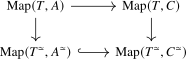
is a pullback square. The vertical functors are constructed by restricting evaluation to \(\Map (T,A)\times T^{\simeq }\) and \(\Map (T,C)\times T^{\simeq }\), factoring through the corresponding groupoid cores, and currying.
Definition 1.5.10. A collection of objects of an \(\infty \)-category \(C\) is a monomorphism \(\Gamma \hookrightarrow C^{\simeq }\). The endpoint functors on \(\Ar (C)\) restrict along the groupoid cores to functors \(s,t\colon \Map ([1],C)\to C^{\simeq }\), for which we use the same notation. Given a collection of objects \(\Gamma \), we define \(M_{\Gamma }\) as the following pullback:
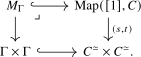
The collection \(M_{\Gamma }\) is closed under composition, since identities and composites have endpoints in \(\Gamma \) whenever the original morphisms do. Hence Axiom H.2 determines a monomorphism \(\lra {M_{\Gamma }}_C \hookrightarrow C\). We refer to the subcategory \(\lra {M_{\Gamma }}_C\) of \(C\) as the full subcategory spanned by the objects in \(\Gamma \).
Proposition 1.5.11 (Full subcategories from collections of objects). The functor \(\lra {M_{\Gamma }}_C \hookrightarrow C\) is a full subcategory inclusion, and there is an equivalence \[ \lra {M_{\Gamma }}_C^{\simeq }\simeq \Gamma \] over \(C^{\simeq }\).
Proof guide. Combine the pullback in Axiom H.1, first for \(T=*\) and then for general \(T\), with the pullback defining \(M_{\Gamma }\). For \(T=*\), pullback pasting identifies the core of \(\lra {M_{\Gamma }}_C\) with \(\Gamma \times _{C^{\simeq }}\Gamma \), which is equivalent to \(\Gamma \) because \(\Gamma \to C^{\simeq }\) is a monomorphism. For general \(T\), the same comparison says that a functor \(T\to C\) factors through \(\lra {M_{\Gamma }}_C\) precisely when its restriction to \(T^{\simeq }\) factors through \(\Gamma \). Details are given in the online supplementary material.
Recognizing equivalences
Recall that a functor between classical 1-categories is an equivalence if and only if it is both fully faithful and essentially surjective. The same statement is true for \(\infty \)-categories. Since this is such a fundamental result, we will take it as one of our axioms.
Definition 1.5.12. A functor \(F\colon C \to D\) is called fully faithful if for every pair of objects \(x\) and \(y\) of \(C\), the induced map of animae \[ F\colon \Hom _C(x,y) \to \Hom _D(Fx,Fy) \] is an equivalence.
Definition 1.5.13. A functor \(F\colon C \to D\) is called essentially surjective if for every object \(y\) of \(D\) there exists an object \(x\) of \(C\) together with an isomorphism \(Fx \cong y\).
Axiom I (Joyal). A functor \(F\colon C \to D\) is an equivalence if and only if it is fully faithful and essentially surjective.
Exercise 1.5.14. Show that a functor \(F\colon C \to D\) is an equivalence if and only if the induced functor \[ F_*\colon \Map ([1],C) \to \Map ([1],D) \] is an equivalence.
Proposition 1.5.15 (Fully faithful functors and full subcategories). A functor \(F\colon C \to D\) is fully faithful if and only if it is a full subcategory inclusion in the sense of Definition 1.5.9.
A proof is given in the online supplementary material.
Another statement familiar from classical category theory is that natural isomorphisms can be checked pointwise. We will also assume this result as a black-box.
Axiom J (Joyal). Let \(F,G\colon C \to D\) be two functors and let \(\alpha \colon F \Rightarrow G\) be a natural transformation. Then \(\alpha \) is a natural isomorphism if and only if for every object \(x\) of \(C\) the morphism \(\alpha (x)\colon F(x) \to G(x)\) is an isomorphism in \(D\).
Remark 1.5.16. It is possible to formulate axioms for \(\infty \)-categories that would allow one to deduce Axiom I, Axiom J.
1.5.3 Localizations
Another important \(\infty \)-categorical construction is that of localizations, where we formally invert a collection of morphisms in an \(\infty \)-category.
Definition 1.5.17. Let \(C\) be an \(\infty \)-category, and let \(W \hookrightarrow \Map ([1],C)\) be a collection of morphisms in \(C\). We say that a functor \(F\colon C \to D\) inverts the morphisms in \(W\) if for every morphism \(f\colon x \to y\) in \(C\) contained in \(W \subseteq \Map ([1],C)\), the image \(F(f)\colon F(x) \to F(y)\) is invertible in \(D\). We let \(\Fun ^{W}(C,D)\) be the full subcategory of \(\Fun (C,D)\) spanned by those functors that invert the morphisms in \(W\).
Exercise 1.5.18. Make the definition of \(\Fun ^W(C,D)\) precise by constructing the corresponding collection of objects of \(\Fun (C,D)\). Hint: Pull back the collection of isomorphisms in \(D\) along the functor which records the action of a functor \(C\to D\) on the morphisms in \(W\).
Definition 1.5.19 (Localization). Let \(C\) be an \(\infty \)-category, and let \(W \hookrightarrow \Map ([1],C)\) be a collection of morphisms in \(C\). We say that a functor \(l\colon C \to L\) is a localization of \(C\) at \(W\) if \(l\) inverts the morphisms in \(W\), and if for every \(\infty \)-category \(D\), the functor \[ l^*\colon \Fun (L,D) \to \Fun (C,D) \] is a full subcategory inclusion which identifies \(\Fun (L,D)\) with the full subcategory \(\Fun ^W(C,D)\).
Note that the universal property of localizations uniquely determines the localization. We will generally denote such a localization by \(C[W^{-1}]\).
Axiom K (Existence of localizations). Let \(C\) be an \(\infty \)-category, and let \(W \hookrightarrow \Map ([1],C)\) be a collection of morphisms in \(C\). Then there exists a localization \(l\colon C \to C[W^{-1}]\) of \(C\) at \(W\).
Remark 1.5.20 (See Chapterexercise 1.10). One can show that the functor \(p_{[1]}\colon [1] \to *\) exhibits \(*\) as the localization of \([1]\) at the collection \(W = \Map ([1],[1])\) of all its morphisms.
Exercise 1.5.21. Let \(l\colon C \to C[W^{-1}]\) be a localization of \(C\) at a collection of morphisms \(W \hookrightarrow \Map ([1],C)\). Show that \(l\) can be computed by the following pushout square of \(\infty \)-categories:
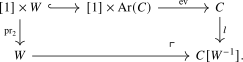
Hint: Show that if \(i\) is a full subcategory inclusion, then so is \(\Fun (W,i)\), and then use Chapterexercise 1.10, Chapterexercise 1.8.
Definition 1.5.22. We define the geometric realization \(\geom {C}\) of an \(\infty \)-category \(C\) as the localization \(C[W^{-1}]\), where \(W := \Map ([1],C)\) is the collection of all morphisms in \(C\).
Remark 1.5.23. The terminology ‘geometric realization’ will be justified in Lemma 24.2.5, where we will show that \(\geom {C}\) is equivalent to the geometric realization (i.e. colimit) of the nerve \(N(C)\colon \simp \catop \to \An \) of \(C\).
Exercise 1.5.24. Let \(C\) and \(D\) be \(\infty \)-categories with collections of morphisms \(W\) and \(W'\), respectively, and assume that both collections contain all identity morphisms. Use the universal property to show that \[ (C \times D)[(W \times W')^{-1}] \iso C[W^{-1}] \times D[{W'}^{-1}]. \] Deduce that \(\geom {C \times D} \iso \geom {C} \times \geom {D}\).
Generated from the authoritative LaTeX source.