We now record the ambient constructions on \(\infty \)-categories that we will use throughout the book: terminal and initial categories, products and coproducts, pullbacks, functor categories, and pushouts. Each is introduced through its universal property, expressed only to the level of coherence that we will actually need later on.
1.3.1 Products and coproducts
We start with products and coproducts of \(\infty \)-categories.
Axiom C.1 (Products and coproducts of \(\infty \)-categories). Let \(I\) be a set and let \(C_i\) be an \(\infty \)-category for every \(i \in I\).
- (1)
-
There is a product \(\prod _{i \in I} C_i\), equipped with projection functors \(\pr _i\colon \prod _{i \in I} C_i \to C_i\) for every \(i\). Given another \(\infty \)-category \(T\) and functors \(f_i\colon T \to C_i\) for every \(i\), we obtain a functor \((f_i)\colon T \to \prod _{i \in I} C_i\) together with natural isomorphisms \(\pr _i \circ (f_i) \cong f_i\). Given two functors \(g,h\colon T \to \prod _{i \in I} C_i\) and natural isomorphisms \(\pr _i \circ g \cong \pr _i \circ h\), there is a natural isomorphism \(g \cong h\).
- (2)
-
There is a coproduct or disjoint union \(\bigsqcup _{i \in I} C_i\), equipped with inclusion functors \(\incl _i\colon C_i \hookrightarrow \bigsqcup _{i \in I} C_i\) for every \(i\). Given another \(\infty \)-category \(T\) and functors \(f_i\colon C_i \to T\) for every \(i\), we obtain a functor \(\lra {f_i}\colon \bigsqcup _{i \in I} C_i \to T\) together with natural isomorphisms \(\lra {f_i} \circ \incl _i \cong f_i\). Given two functors \(g,h\colon \bigsqcup _{i \in I} C_i \to T\) and natural isomorphisms \(g \circ \incl _i \cong h \circ \incl _i\), there is a natural isomorphism \(g \cong h\).
Notation 1.3.1. For the empty-index cases, we write the resulting product and coproduct as \(*\) and \(\emptyset \), respectively. Thus every \(\infty \)-category \(C\) comes equipped with canonical functors \[ C \to *, \qquad \qquad \emptyset \to C. \]
Remark 1.3.2. We further assume that the canonical functor \([0] \to *\) is an equivalence. In particular, objects of an \(\infty \)-category \(C\) may equally well be regarded as functors \([0] \to C\) or as functors \(* \to C\).
In these empty-index cases we also silently assume one extra layer of coherence: any two natural isomorphisms between two functors \(T \to *\) are connected by a 3-isomorphism, and similarly for functors \(\emptyset \to T\). This mild strengthening is only used when comparing products with pullbacks over \(*\) and coproducts with pushouts under \(\emptyset \), for instance in Exercise 1.3.10.
Notation 1.3.3. When \(I = \{1,2\}\), we write \(C_1 \times C_2\) and \(C_1 \sqcup C_2\) for the resulting product and coproduct. Given functors \(f_1\colon T \to C_1\) and \(f_2\colon T \to C_2\), we write \((f_1,f_2)\colon T \to C_1 \times C_2\) for the induced functor. Given functors \(g_1\colon C_1 \to T\) and \(g_2\colon C_2 \to T\), we write \(\lra {g_1,g_2}\colon C_1 \sqcup C_2 \to T\) for the induced functor.
Taking \(T = *\), we see that objects of \(C_1 \times C_2\) have the form \((x,y)\), where \(x\) is an object of \(C_1\) and \(y\) is an object of \(C_2\).
Definition 1.3.4. Let \(C\) and \(D\) be \(\infty \)-categories and let \(x\) be an object of \(D\), regarded as a functor \(x\colon * \to D\). We define the constant functor \(\const _x\colon C \to D\) as the following composite: \[ \const _x\colon C \xrightarrow {p_C} * \xrightarrow {x} D. \]
Definition 1.3.5 (Contractible category). An \(\infty \)-category \(C\) is called contractible if the functor \(p_{C}\colon C \to *\) is an equivalence.
Observe that an \(\infty \)-category \(C\) is contractible if and only if there exists an object \(x\colon * \to C\) such that the composite \(\const _x\colon C \to C\) is naturally isomorphic to the identity \(\id _C\colon C \to C\). A natural isomorphism \(H\colon \const _x \cong \id _C\) is called a contraction of \(C\) onto \(x\).
The familiar symmetries of products and coproducts follow from these universal properties just as in ordinary category theory, and we will use them freely.
Exercise 1.3.6. Show that (co)products of \(\infty \)-categories are associative, commutative and unital: \[ C \times D \iso D \times C, \qquad (C \times D) \times E \iso C \times (D \times E), \qquad C \times * \iso C \iso * \times C, \] and \[ C \sqcup D \iso D \sqcup C, \qquad (C \sqcup D) \sqcup E \iso C \sqcup (D \sqcup E), \qquad \emptyset \sqcup C \iso C \iso C \sqcup \emptyset . \]
Construction 1.3.7. The formation of products and coproducts of \(\infty \)-categories is functorial: given two functors \(f\colon C \to C'\) and \(g\colon D \to D'\), we obtain new functors \begin {align*} f \times g \; &:= \; (f \circ \pr _{C}, g \circ \pr _{D}) \colon \; C \times D \to C' \times D' \\ f \sqcup g \; &:= \; \lra {\incl _{C'} \circ f, \incl _{D'} \circ g} \; \colon C \sqcup D \to C' \sqcup D'. \end {align*}
We leave it to the reader to verify that there are natural isomorphisms \begin {align*} \id _{C} \times \id _{D} \cong \id _{C \times D} &\quadtext { and } (f' \times g') \circ (f \times g) \cong (f' \circ f) \times (g' \circ g), \\ \id _{C} \sqcup \id _{D} \cong \id _{C \sqcup D} &\quadtext { and } (f' \sqcup g') \circ (f \sqcup g) \cong (f' \circ f) \sqcup (g' \circ g) \end {align*}
for functors \(f\colon C \to C'\), \(f'\colon C' \to C''\), \(g\colon D \to D'\) and \(g'\colon D' \to D''\).
1.3.2 Pullbacks of \(\infty \)-categories
We will now axiomatize the pullback of two functors \(f\colon C \to E\) and \(g\colon D \to E\) of \(\infty \)-categories. This will be similar to the axiom for the product \(C \times D\), but it is more involved due to the fact that we need to record compatibilities with the structure maps to \(E\).
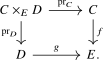
Axiom C.2 (Pullbacks of \(\infty \)-categories). Consider two functors \(f\colon C \to E\) and \(g\colon D \to E\). Their pullback, or fiber product over \(E\), is an \(\infty \)-category \(C \times _{E} D\) equipped with functors \(\pr _{C} \colon C \times _{E} D \to C\) and \(\pr _{D}\colon C \times _{E} D \to D\) and a natural isomorphism \(f \circ \pr _{C} \cong g \circ \pr _{D}\), or equivalently a commutative square
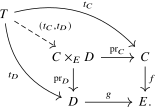
Given functors \(t_C\colon T \to C\) and \(t_D\colon T \to D\) equipped with a natural isomorphism \(\alpha \colon f \circ t_C \cong g \circ t_D\), we obtain a functor \(t = (t_C,t_D)\colon T \to C \times _{E} D\). This functor comes equipped with natural isomorphisms \(\pr _{C} \circ t \cong t_C\) and \(\pr _{D} \circ t \cong t_D\), and the composite isomorphism \[ f \circ t_C \cong f \circ \pr _{C} \circ t \cong g \circ \pr _{D} \circ t \cong g \circ t_D \] is isomorphic to \(\alpha \). We summarize this by the following dashed-arrow diagram:1
Similarly, if \(t,t'\colon T \to C \times _{E} D\) are two functors and \(\alpha \colon \pr _{C} \circ t \cong \pr _{C} \circ t'\) and \(\beta \colon \pr _{D} \circ t \cong \pr _{D} \circ t'\) are natural isomorphisms compatible over \(E\), in the sense that the following square commutes,
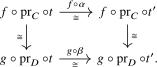
Then we obtain a natural isomorphism \((\alpha ,\beta )\colon t \cong t'\) satisfying \(\pr _{C} \circ (\alpha ,\beta ) \cong \alpha \) and \(\pr _{D} \circ (\alpha ,\beta ) \cong \beta \), and inducing an isomorphic isomorphism of natural isomorphisms in the previous square.
Remark 1.3.8. Despite the heavier notation, Axiom C.2 has exactly the same formal shape as the product part of the previous axiom: it introduces an \(\infty \)-category with structure, explains how compatible data on \(T\) determines a functor \(T \to X\), and says that such functors are determined up to natural isomorphism by that data. For a fully precise formulation of the final compatibility condition, we refer to Reference ? of [Cisinski et al. (2026)].
Exercise 1.3.9. Show that the fiber product is commutative, associative and unital: for functors \(C\to E\), \(D \to E\) and \(B \to E\), there are equivalences \[ C \times _{E} D \iso D \times _{E} C, \qquad B \times _{E} (C \times _{E} D) \iso (B \times _{E} C) \times _{E} D, \qquad C \times _{E} E \iso C. \]
Exercise 1.3.10. Given \(\infty \)-categories \(C\) and \(D\), produce an equivalence \(C \times D \iso C \times _* D\).
Exercise 1.3.11. The construction of pullbacks of \(\infty \)-categories is functorial: given a commutative diagram
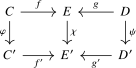
there is an induced functor \[ \phi \times _{\chi } \psi := (\phi \circ \pr _{C}, \psi \circ \pr _{D})\colon C \times _{E} D \to C' \times _{E'} D'. \] Show that if each of the functors \(\phi \), \(\psi \) and \(\chi \) is an equivalence, then so is \(\phi \times _{\chi } \psi \). Deduce that equivalences are stable under pullback: if \(g\colon D \to E\) is an equivalence and \(f\colon C \to E\) is an arbitrary functor, then the projection \(C \times _{E} D \to C\) is an equivalence.
Pullbacks of categories lead to the notion of a fiber of a functor:
Definition 1.3.12. Let \(f\colon C \to D\) be a functor. For every object \(x\) of \(D\), we define the fiber of \(f\) over \(x\) as the pullback

The definition of pullbacks of \(\infty \)-categories naturally leads to the notion of a pullback square.
Definition 1.3.13 (Pullback square). A commutative square

is called a pullback square if the induced functor \((s,t)\colon T \to C \times _{E} D\) is an equivalence.
Exercise 1.3.14 (Iterated pullbacks). Consider a commutative diagram
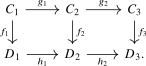
Construct an equivalence \[ D_1 \times _{D_3} C_3 \iso D_1 \times _{D_2} (D_2 \times _{D_3} C_3). \] Hint: define one direction by \((\pr _{D_1}, (h_1 \circ \pr _{D_1}, \pr _{C_3}))\) and construct an inverse by projecting to \(D_1\) and \(C_3\).
Lemma 1.3.15 (Pasting lemma for pullback squares). Consider a commutative diagram
If the right-hand square is a pullback square, then the left-hand square is a pullback square if and only if the outer rectangle is a pullback square.
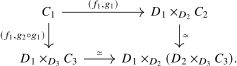
Proof. By the previous exercise there is a preferred equivalence \[ D_1 \times _{D_3} C_3 \iso D_1 \times _{D_2} (D_2 \times _{D_3} C_3). \] If the right-hand square is a pullback square, the functor \(C_2 \to D_2 \times _{D_3} C_3\) is an equivalence. Hence, by Exercise 1.3.11, the induced functor \(D_1 \times _{D_2} C_2 \to D_1 \times _{D_2} (D_2 \times _{D_3} C_3)\) is an equivalence. The claim now follows from 2-out-of-3 applied to the square
□
Exercise 1.3.16. Consider a commutative square

and assume that \(h\) is an equivalence. Show that \(g\) is an equivalence if and only if the square is a pullback square.
We record one further property of coproducts.
Axiom C.3 (Universality of coproducts). Let \(I\) be a set, and let \(D_i\) be an \(\infty \)-category for every \(i \in I\).
- (1)
-
Given functors \(f_i\colon C_i \to D_i\) for all \(i \in I\), the commutative square
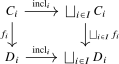
is a pullback square.
- (2)
-
For a functor \(h\colon E \to \bigsqcup _{i \in I} D_i\), the functor \[ \lra {\pr _E}_i \colon \bigsqcup _{i \in I}(E \times _{\bigsqcup _{i \in I} D_i} D_i) \to E \] is an equivalence.
- (3)
-
The inclusions \(\{i\} \hookrightarrow I\) for \(i \in I\) induce an equivalence \(\bigsqcup _{i \in I} \{i\} \iso I\).
Remark 1.3.17. This is the categorical analogue of three basic facts about disjoint unions of sets: base change along an inclusion picks out the corresponding summand, every map into a disjoint union decomposes the source into the corresponding fibers, and every set is the disjoint union of its elements.
1.3.3 Functor categories
Functor categories let us package families of functors internally, and they will also allow us to define pushouts by duality in the next subsection.
Axiom C.4 (Functor category). The functor category between two \(\infty \)-categories \(C\) and \(D\) is an \(\infty \)-category denoted by \(\Fun (C, D)\). It comes equipped with a functor \(\ev \colon \Fun (C,D) \times C \to D\), called the evaluation functor. If \(E\) is another \(\infty \)-category, then every functor \(f\colon E \times C \to D\) gives rise to a functor \(f_c \colon E \to \Fun (C,D)\) called the currying of \(f\). It comes equipped with a natural isomorphism between \(f\) and the composite \[ E \times C \xrightarrow {f_c \times \id _C} \Fun (C,D) \times C \xrightarrow {\ev } D. \] Given two functors \(g,h\colon E \to \Fun (C,D)\) and a natural isomorphism \(\alpha \colon \ev \circ (g \times \id _C) \cong \ev \circ (h \times \id _C)\), we obtain a natural isomorphism \(\beta \colon g \cong h\) such that \(\alpha \cong \ev \star (\beta \times \id _C)\).
Remark 1.3.18. Given a functor \(g\colon E \to \Fun (C,D)\), we define its uncurrying \(g^u\colon E \times C \to D\) as the composite \[ E \times C \xrightarrow {g \times \id _C} \Fun (C,D) \times C \xrightarrow {\ev } D. \] Thus currying and uncurrying pass between functors \(E \times C \to D\) and functors \(E \to \Fun (C,D)\), and going back and forth both ways is naturally isomorphic to the identity. In the case \(E = *\), we observe that objects \(* \to \Fun (C, D)\) of the functor category correspond to functors \(C \simeq C \times * \to D\) from \(C\) to \(D\), justifying the terminology for \(\Fun (C,D)\).
Exercise 1.3.19. Show that currying and uncurrying are functorial in the parameter category \(E\) and compatible with natural isomorphisms.
The functoriality of the product naturally provides functoriality for the functor categories:
Construction 1.3.20 (Functoriality of functor categories in \(C\) and \(D\)). Given a functor \(g\colon D \to E\), we define the functor \(g \circ -\colon \Fun (C,D) \to \Fun (C,E)\) as the currying of the composite \[ \Fun (C, D) \times C \xrightarrow {\ev } D \xrightarrow {g} E. \] Similarly, given a functor \(f\colon C \to D\), we define the functor \(- \circ f\colon \Fun (D,E) \to \Fun (C,E)\) as the currying of the composite \[ \Fun (D, E) \times C \xrightarrow {\id \times f} \Fun (D,E) \times D \xrightarrow {\ev } E. \] In a completely analogous way, every natural isomorphism \(\beta \colon g \cong g'\) of functors \(D \to E\) induces a natural isomorphism \((\beta \circ -) \colon (g \circ -) \cong (g' \circ -)\) of functors \(\Fun (C,D) \to \Fun (C, E)\), and similarly for the construction \(- \circ f\).
Alternative notations for these functors that we will frequently use are \(g_*\) and \(f^*\): \[ g_* := g \circ -\colon \Fun (C,D) \to \Fun (C,E), \qquad f^*:= - \circ f\colon \Fun (D,E) \to \Fun (C,D). \]
Exercise 1.3.21. Formulate and prove that the assignments \(g \mapsto (g \circ -)\) and \(f \mapsto (- \circ f)\) are functorial, in the sense that they respect identity functors and composition of functors.
Exercise 1.3.22. Given \(\infty \)-categories \(C\), \(D\) and \(E\), construct a composition functor \[ - \circ -\colon \Fun (D,E) \times \Fun (C,D) \to \Fun (C,E). \] Show that it reduces to the functors \(g \circ -\) and \(- \circ f\) when fixing one of the two variables.
Exercise 1.3.23. Let \(f,g\colon C \to D\) be two functors of \(\infty \)-categories, regarded as objects of \(\Fun (C,D)\). We may define a new \(\infty \)-category \((f \cong g)\) via the following pullback square:
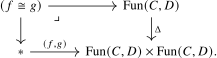
Show that every natural isomorphism \(\alpha \colon f \cong g\) defines an object of \((f \cong g)\). Conversely, show that every object of \((f \cong g)\) defines a natural isomorphism \(\alpha \colon f \cong g\).
Proposition 1.3.24 (Internal universal properties). Let \(T\) be an \(\infty \)-category and let \(\{C_i\}_{i \in I}\) be a set-indexed collection of \(\infty \)-categories. The canonical functors below are equivalences: \begin {align*} \Fun (T,*) &\iso *, & \Fun (\emptyset ,T) &\iso *, & \Fun (*,T) &\iso T, \\ \Fun \left (T,\prod _{i \in I}C_i\right ) &\iso \prod _{i \in I}\Fun (T,C_i), & \Fun \left (\bigsqcup _{i \in I}C_i,T\right ) &\iso \prod _{i \in I}\Fun (C_i,T). \end {align*}
Moreover, for functors \(f\colon C \to E\) and \(g\colon D \to E\) there is an equivalence \[ \Fun (T,C \times _E D) \iso \Fun (T,C) \times _{\Fun (T,E)} \Fun (T,D), \] and for \(\infty \)-categories \(C\) and \(D\) there is an equivalence \[ \Fun (T,\Fun (C,D)) \iso \Fun (T \times C,D). \]
Proof guide. Construct the comparison functors from the projections, inclusions, evaluation, and currying maps. To construct their inverses as actual functors, first uncurry: the product and pullback axioms assemble the resulting evaluation maps, after which one curries again. In the coproduct case, first use universality of coproducts to distribute the product with the parameter category over \(\bigsqcup _iC_i\). The uniqueness clauses then give the two inverse relations. A complete proof is given in the online supplementary material. See also Reference ? of [Cisinski et al. (2026)].
1.3.4 Pushouts of \(\infty \)-categories
Using functor categories, we may now dualize the notion of pullback square and define pushouts:
Definition 1.3.25 (Pushout square). A commutative square of \(\infty \)-categories

is called a pushout square (or cocartesian) if, for every \(\infty \)-category \(E\), the induced square
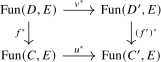
is a pullback square.
Axiom C.5 (Pushout of \(\infty \)-categories). For functors \(f\colon E \to C\) and \(g\colon E \to D\), there exists a pushout square
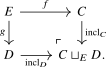
We refer to the \(\infty \)-category \(C \sqcup _E D\) as the pushout of \(C\) and \(D\) along \(E\).
Lemma 1.3.26 (Pasting lemma for pushout squares). Consider a commutative diagram
If the left-hand square is a pushout square, then the right-hand square is a pushout square if and only if the outer rectangle is a pushout square.
Proof. This follows immediately from Lemma 1.3.15. □
Notes
Generated from the authoritative LaTeX source.