Lemma 1.3.15 (Pasting lemma for pullback squares). Consider a commutative diagram
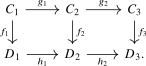
If the right-hand square is a pullback square, then the left-hand square is a pullback square if and only if the outer rectangle is a pullback square.
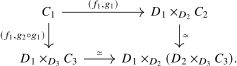
Proof. By the previous exercise there is a preferred equivalence \[ D_1 \times _{D_3} C_3 \iso D_1 \times _{D_2} (D_2 \times _{D_3} C_3). \] If the right-hand square is a pullback square, the functor \(C_2 \to D_2 \times _{D_3} C_3\) is an equivalence. Hence, by Exercise 1.3.11, the induced functor \(D_1 \times _{D_2} C_2 \to D_1 \times _{D_2} (D_2 \times _{D_3} C_3)\) is an equivalence. The claim now follows from 2-out-of-3 applied to the square
□
Generated from the authoritative LaTeX source.