Theorem 5.2.5 (Descent for colimits). Let \(I\) be a small \(\infty \)-category, let \(\overline {F}, \overline {G} \colon I^{\triangleright } \to \An \) be functors and let \(\overline {\alpha }\colon \overline {F} \Rightarrow \overline {G}\) be a natural transformation such that the restriction \(\alpha := \overline {\alpha }\vert _I \colon F \Rightarrow G\) is a cartesian transformation, in the sense that for every morphism \(i \to j\) in \(I\) the commutative square
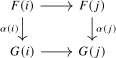
is a pullback square. Assume that \(\overline {G}\) is a colimit diagram. Then \(\overline {F}\) is a colimit
diagram if and only if \(\overline {\alpha }\) is a cartesian transformation, i.e. also all the squares \begin {equation*} 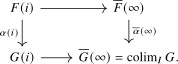
Proof. See Section 23.7; see also [Lurie (2009), Theorem 6.1.3.9]. □
Generated from the authoritative LaTeX source.