An important property that distinguishes the \(\infty \)-category \(\An \) from other \(\infty \)-categories is a property called descent. We have already encountered this property in the proof of the Recognition Principle (Theorem 5.2.5). In this section, we give a self-contained treatment.
Definition 23.7.1 (Descent). Let \(I\) be a small \(\infty \)-category, and let \(T\) be an \(\infty \)-category with pullbacks and \(I\)-indexed colimits. We say that \(T\) satisfies descent for \(I\)-indexed colimits if the functor \[ T\catop \to \Cat , \qquad X \mapsto T_{/X} \] preserves \(I\)-indexed limits.
Definition 23.7.2 (\(\infty \)-Topos). An \(\infty \)-topos is a presentable \(\infty \)-category satisfying descent for all small colimits.
Let us unwind Definition 23.7.1. Given a small \(\infty \)-category \(I\) and an \(I\)-indexed diagram \(X_{\bullet } \colon I \to T\), set \(X := \colim _i X_i\). The descent condition demands that the canonical functor \(T_{/X} \to \lim _i T_{/X_i}\), obtained from the base change functors along the maps \(X_i \to X\), is an equivalence.
Proof. We need to show that for any functor \(X_{\bullet }\colon I \to \An \), with colimit \(X_{\infty } := \colim _i X_i\), the functor \(\An _{/X_{\infty }} \to \lim _i \An _{/X_i}\) is an equivalence. By Corollary 23.2.8, we have an equivalence \(\An _{/Y} \iso \Fun (Y,\An )\) which is natural in \(Y\). So, the claim is equivalent to showing that the map \[ \Fun (X_{\infty },\An ) \to \lim _i \Fun (X_i,\An ) \] is an equivalence. But this follows from the fact that \(\Fun (-,\An )\colon \An \catop \to \Cat \) sends colimits in \(\An \) to limits in \(\Cat \). □
To understand the descent condition better, we provide an alternative description of the limit \(\lim _i T_{/X_i}\) in terms of cartesian natural transformations.
Definition 23.7.4 (Cartesian natural transformation). Given two functors \(F,G\colon I \to T\), a natural transformation \(\alpha \colon F \to G\) is
called cartesian if for every morphism \(i \to j\) in \(I\) the naturality square \begin {equation*} 
Given a diagram \(X_{\bullet }\colon I \to T\), evaluation at \(i \in I\) determines a functor \(\ev _i\colon \Fun ^{\cart }(I,T)_{/X_{\bullet }} \to T_{/X_i}\). Furthermore, by definition of cartesianness these evaluation functors are compatible with base change, resulting in a comparison functor \(\Fun ^{\cart }(I,T)_{/X_{\bullet }} \to \lim _{i \in I\catop } T_{/X_i}\).
Lemma 23.7.5. Let \(C\) be an \(\infty \)-category with pullbacks and let \(X_{\bullet }\colon I \to C\) be a functor. Then the functor \(\Fun ^{\cart }(I,C)_{/X_{\bullet }} \to \lim _{i \in I\catop } C_{/X_i}\) is an equivalence.
More informally, objects of the limit are given by \(I\)-indexed diagrams \(Y_{\bullet }\) in \(C\) equipped with a cartesian natural transformation \(Y_{\bullet } \to X_{\bullet }\).
Proof. Recall that a limit of a diagram \(I\catop \to \Cat \) of \(\infty \)-categories may be computed as the \(\infty \)-category of
cartesian sections of the cartesian unstraightening of the diagram. By definition, the functor \(C_{/-}\colon C\catop \to \Cat \) is
the cartesian straightening of the target map \(t\colon \Ar (C) \to C\), so the unstraightening of \(C_{/-}\) is \(t\). It follows that the
unstraightening of the functor \(i \mapsto C_{/X_i}\) is the base change of \(t\) along \(X_{\bullet }\): \begin {equation*} 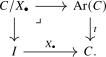
With this alternative description of \(\lim _i T_{/X_i}\) at hand, we can show that the functor \(T_{/X} \to \lim _i T_{/X_i}\) admits a left adjoint:
Lemma 23.7.6. Let \(T\) be an \(\infty \)-category with pullbacks and \(I\)-indexed colimits, and let \(X = \colim _i X_i\) be a colimit in \(T\). Then the functor \(T_{/X} \to \lim _i T_{/X_i}\) admits a left adjoint \[ \colim \colon \lim _i T_{/X_i} \to T_{/X} \] sending a cartesian transformation \(Y_{\bullet } \to X_{\bullet }\) to its colimit \(\colim _i Y_i \to \colim _i X_i\).
Proof. The colimit functor \(\colim \colon \Fun (I,T) \to T\) admits a right adjoint \(\const \colon T \to \Fun (I,T)\) sending an object \(Y\) to the constant functor on \(Y\). By slicing this adjunction over an arbitrary diagram \(X_{\bullet } \in \Fun (I,T)\), with colimit denoted \(X\), we obtain another adjunction \[ \colim \colon \Fun (I,T)_{/X_{\bullet }} \rightleftarrows T_{/X}, \] see [Lurie (2009), Proposition 5.2.5.1]. The right adjoint in this adjunction is given by the composite \(T_{/X} \xrightarrow {\const } \Fun (I,T)_{/\const X} \to \Fun (I,T)_{/X_{\bullet }}\), with the second map given by base change along the colimit cocone \(X_{\bullet } \to \const _X\). We now make the following two observations:
- The \(\infty \)-category \(\Fun (I,T)_{/X_{\bullet }}\) contains the limit \(\lim _{i \in I\catop } C_{/X_i} \simeq \Fun ^{\cart }(I,T)_{/X_{\bullet }}\) as a full subcategory: given transformations \(Y_{\bullet } \to Z_{\bullet } \to X_{\bullet }\), if both \(Z_{\bullet } \to X_{\bullet }\) and \(Y_{\bullet } \to X_{\bullet }\) are cartesian transformations, then so is \(Y_{\bullet } \to Z_{\bullet }\) by the pasting law for pullback squares.
- Since any transformation \(\const Y \to \const X\) between constant diagrams is cartesian, and cartesian transformations are closed under base change, the right adjoint \(T_{/X} \to \Fun (I,T)_{/X_{\bullet }}\) lands in this full subcategory.
It follows that the adjunction restricts to an adjunction \(\lim _i T_{/X_i} \rightleftarrows T_{/X}\), as desired. □
We can now characterize when the functor \(T_{/X} \to \lim _i T_{/X_i}\) is an equivalence. By Lemma 23.7.6, this happens precisely when the unit and counit of the adjunction are natural isomorphisms.
Lemma 23.7.7. Let \(T\) be an \(\infty \)-category with pullbacks and \(I\)-indexed colimits, and let \(X_{\bullet } \colon I \to T\) be a diagram with colimit \(X := \colim _i X_i\). Then \(T\) satisfies descent for \(I\)-indexed colimits if and only if the following two conditions hold:
- (1)
-
For any map \(Y \to X\), the canonical map \(\colim _i (X_i \times _X Y) \to Y\) is an isomorphism.
- (2)
-
Given a cartesian transformation \(Y_{\bullet } \to X_{\bullet }\), each map \(Y_i \to (\colim _j Y_j) \times _X X_i\) is an isomorphism.
Proof. By definition, \(T\) satisfies descent for \(I\)-indexed colimits if and only if the canonical functor \(T_{/X} \to \lim _i T_{/X_i}\) is an equivalence. By Lemma 23.7.6, this functor admits a left adjoint given by sending a cartesian transformation \(Y_{\bullet } \to X_{\bullet }\) to its colimit. The functor is an equivalence if and only if both the unit and counit of this adjunction are isomorphisms. The counit at \(Y \to X\) is precisely the map in (1), while the unit at a cartesian transformation \(Y_{\bullet } \to X_{\bullet }\) consists of the maps in (2). □
23.7.1 Examples of descent
Let us illustrate the descent condition by giving some examples.
Example 23.7.8 (Strictly initial object). Let \(T\) be an \(\infty \)-category with an initial object. Then the initial object \(\emptyset \) satisfies descent if and only if it is strictly initial, meaning that any morphism \(X \to \emptyset \) is an isomorphism.
Indeed, by definition \(\emptyset \) satisfies descent if and only if the functor \(T_{/\emptyset } \to *\) is an equivalence. This functor admits a fully faithful left adjoint \(* \to T_{/\emptyset }\) hitting the identity \(\id _{\emptyset }\). For the functor to be an equivalence, the counit \(\emptyset \to X\) must be an isomorphism for every \(X \in T_{/\emptyset }\), which is precisely the strict initiality condition.
Example 23.7.9 (Disjoint coproducts). For an \(\infty \)-category \(T\) with arbitrary coproducts, we say that coproducts are disjoint if for all \(X, Y \in T\) the diagram

is a pullback square. We claim that arbitrary coproducts in \(T\) satisfy descent if and only if they are universal and \(T\) has disjoint coproducts.
By Lemma 23.7.7, coproducts satisfy descent if and only if for every collection of maps \(\{Y_i \to X_i\}_{i \in I}\) the commutative square
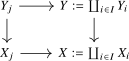
is a pullback square for every \(j \in I\). To see that this reduces to disjointness, consider \(X' := \coprod _{i \in I \setminus \{j\}} X_i\) and \(Y' := \coprod _{i \in I \setminus \{j\}} Y_i\). We may write \(X = X_j \sqcup X'\) and \(Y = Y_j \sqcup Y'\). Invoking universality of coproducts once more shows that the condition reduces to disjointness of binary coproducts.
Example 23.7.10 (Grothendieck construction). Let \(T\) be an \(\infty \)-topos. Given an anima \(A \in \An \), we obtain an equivalence \[ \Fun (A,T) \quad =\quad \lim _A T_{/*} \quad \simeq \quad T_{/\,\colim _A *}. \] We refer to this equivalence as the Grothendieck construction.
Generated from the authoritative LaTeX source.