We may use the results from the previous section to compute the hom animae in a functor category \(\Fun (C,D)\). For this, we introduce the notion of an end in the \(\infty \)-categorical setting.
Definition 23.6.1 (Twisted arrow category). Let \(C\) be an \(\infty \)-category. We define its twisted arrow category \(\Tw (C)\) as the source of the left fibration whose cocartesian straightening is the Hom-functor \(\Hom _C\colon C\catop \times C \to \An \): \[ \Tw (C) := \Un ^{\cc }(\Hom _C\colon C\catop \times C \to \An ). \] In particular, it comes equipped with a left fibration \((s,t)\colon \Tw (C) \to C\catop \times C\) whose fibers are the hom animae of \(C\):
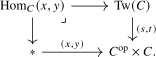
Remark 23.6.2. Under the complete Segal presentation of \(\infty \)-categories from Chapter 24, the twisted arrow category has the edgewise-subdivision model \[ [n]\longmapsto \Hom _{\Cat _{\infty }}([n]\catop \star [n],C). \] The inclusions of the two copies of \([n]\) induce the source and target functors, and the fiber over \((x,y)\) is \(\Hom _C(x,y)\). This gives a model-specific description of the left fibration in the preceding definition.
Unwinding the description of the unstraightening construction, we see that \(\Tw (C)\) may be described as follows:
- The objects of \(\Tw (C)\) are morphisms in \(C\), which we will display as \(\smash {\puto {X}{Y}{\phi }}\). We have \(\smash {s\puto {X}{Y}{\phi }} = X\) and \(\rbox {1.3}{1.5}{\smash {t\puto {X}{Y}{\phi }}} = Y\).
- A morphism \(\smash {\pwto {f}{g}}\colon \smash {\puto {X}{Y}{\phi }} \to \smash {\puto {X'}{Y'}{\phi '}}\) in \(\Tw (C)\) is a triple \((f,g,\alpha )\) consisting of a morphism \(\rbox {1.3}{1.5}{f\colon X \to X'}\) in \(C\catop \) (i.e., \(f\colon X' \to X\) in \(C\)), a morphism \(g\colon Y \to Y'\) in \(C\), and a
morphism \(\alpha \colon (f,g)_!\smash {\puto {X}{Y}{\phi }} = \rbox {1.3}{1.5}{\smash {\puto {X'}{Y'}{g\phi f}}}\to \smash {\puto {X'}{Y'}{\phi '}}\) in the fiber \(\Tw (C)_{(X',Y')} = \Hom _C(X',Y')\). We will display this data by means of diagrams of the form Note that this is not a morphism in the usual arrow category \(\Ar (C)\), since \(f\) points in the opposite direction.

Definition 23.6.3 (End). Let \(C\) be an \(\infty \)-category and consider a functor \(F\colon C\catop \times C \to D\). The end of \(F\), denoted by \(\int _{c \in C} F(c,c)\) if it exists, is the limit of the composite functor \[ \Tw (C) \xrightarrow {(s,t)} C\catop \times C \xrightarrow {F} D. \]
Remark 23.6.4. If \(C\) is small and \(D\) admits small limits, the end of \(F\) always exists. Furthermore, if \(D \to D'\) is a functor preserving small limits, then it also preserves ends.
Lemma 23.6.5 (Fubini rule for ends). Let \(C\) and \(C'\) be \(\infty \)-categories and let \(F\colon C\catop \times C \times {C'}\catop \times C' \to D\) be a functor. Then there is an equivalence \[ \int _{c \in C} \int _{c' \in C'} F(c,c,c',c') \simeq \int _{(c,c') \in C \times C'} F(c,c,c',c'). \]
Proof. Since a limit over a product category may be computed as an iterated limit, it will suffice to produce an equivalence \[ \Tw (C \times C') \simeq \Tw (C) \times \Tw (C') \] of left fibrations over \(C\catop \times C \times {C'}\catop \times C'\). By straightening-unstraightening, it will suffice to produce a natural isomorphism between their unstraightenings: \[ (x,y,x',y') \quad \mapsto \quad \Hom _{C \times C'}((x,x'), (y,y')) \simeq \Hom _C(x,y) \times \Hom _{C'}(x',y'). \] Unwinding the definition of the hom functors, this boils down to the canonical equivalence \[ \Ar (C \times C') \iso \Ar (C) \times \Ar (C') \] over \(C \times C \times C' \times C'\), coming from the fact that \(\Ar (-) = \Fun ([1],-)\) preserves products. □
Proposition 23.6.6 (Hom animae in functor categories). Let \(F,G \colon C \to D\) be functors. Then we have the following end-formula for the anima of natural transformations from \(F\) to \(G\): \[ \Nat (F,G) \quad \simeq \quad \int _{x \in C} \Hom _D(F(x), G(x)). \] Here the right-hand side is the end of the composite functor \(C\catop \times C \xrightarrow {F\catop \times G} D\catop \times D \xrightarrow {\Hom _D} \An \).
Proof. The end imposes precisely the naturality conditions on a pointwise family of morphisms \(F(x)\to G(x)\). The rigorous identification, including all higher coherence data, is proved in Reference ? of [Cisinski et al. (2026)]. □
Proposition 23.6.7. Let \(F\colon I \to C\) be a functor of \(\infty \)-categories. A natural transformation \(\eta \colon F \to \const _x\) exhibits \(x \in C\) as the colimit of \(F\) if and only if the natural map \[ \eta ^*\colon \Hom _C(x,y) \iso \lim _{i \in I\catop } \Hom _C(F(i),y) \] obtained by applying \(\Hom _C(-,y)\) to \(\eta \) is an equivalence for all \(y \in C\). A similar assertion holds for limits.
Proof. Consider the following commutative diagram:

here the right vertical map is induced by the evaluation functors \(\ev _i\colon \Fun (I,C) \to C\). By definition, \(x\) is a colimit of \(F\) if and only if the top map is an equivalence for all \(y\), hence it will suffice to show that the right vertical map is an equivalence. By Proposition 23.6.6, the top right is equivalent to \(\lim _{(i \to i') \in \Tw (I)} \Hom _C(F(i), y)\). It thus remains to show that the forgetful functor \(s\colon \Tw (I) \to I\catop \) is final. By Theorem 21.5.1, it suffices to show that the relative slices are weakly contractible. But these relative slices are weakly equivalent [explain]1 to the actual slices \(I_{i/}\), which have initial objects, so the claim follows from Lemma 21.5.6. □
Corollary 23.6.8. The functors \(Y_C\colon C \hookrightarrow \Fun (C\catop ,\An )\) and \(Y_{C\catop }\colon C\catop \hookrightarrow \Fun (C,\An )\) preserve limits.
Proof. The satement for \(Y_{C\catop }\) is immediate from Proposition 23.6.7. The other one is proved dually, or may be recovered by replacing \(C\) by \(C\catop \). □
Notes
1There is an adjunction \(\Tw (I)_{i/} \rightleftarrows I_{i/}\), and we have Lemma 21.1.7
Generated from the authoritative LaTeX source.