As a consequence of straightening/unstraightening, we obtain explicit formulas for limits and colimits in \(\Cat _{\infty }\).
Construction 23.5.1. Let \(p\colon E \to I\) be a cocartesian fibration.
- We write \(E[\cc ^{-1}]\) for the localization of \(E\) at the collection of \(p\)-cocartesian morphisms.
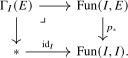
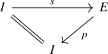
- We write \(\Gamma _I(E)\) for the \(\infty \)-category of sections of \(p\), defined via the following pullback square:
- We write \(\Gamma _I^{\cc }(E)\) for the full subcategory of \(\Gamma _I(E)\) spanned by the cocartesian sections: those sections that are cocartesian functors over \(I\) (i.e., that send arbitary morphisms in \(I\) to \(p\)-cocartesian morphisms in \(E\)).
Proposition 23.5.2. Let \(I\) be a small \(\infty \)-category and let \(F\colon I \to \Cat _{\infty }\) be a functor.
- (1)
-
The functor \(F\) admits a colimit in \(\Cat _{\infty }\), which can be computed by the formula \[ \colim _I F(i) \simeq \Un ^{\cc }(F)[\cc ^{-1}]. \]
- (2)
-
The functor \(F\) admits a limit in \(\Cat _{\infty }\), which can be computed by the formula \[ \lim _I F(i) \simeq \Gamma _I^{\cc }(\Un ^{\cc }(F)). \]
Proof. See Reference ?, Reference ? of [Cisinski et al. (2026)]. □
Proposition 23.5.3 (Fiberwise colimits over cocartesian fibrations). Let \(p\colon E\to J\) be a cocartesian fibration between small \(\infty \)-categories and let \(G\colon E\to C\) be a functor. Assume that the restriction \(G\vert _{E_j}\colon E_j\to C\) admits a colimit for every \(j\in J\). Then the left Kan extension \(p_!G\colon J\to C\) exists and is given pointwise by \[ (p_!G)(j)\simeq \colim _{E_j}G\vert _{E_j}. \] Moreover, \(G\) admits a colimit if and only if \(p_!G\) admits a colimit, and in this case there is an isomorphism \[ \colim _EG\cong \colim _Jp_!G. \] Dually, fiberwise limits over a cartesian fibration assemble into a right Kan extension and may be computed by first taking the fiberwise limits and then the limit over the base.
Proof. See Reference ? of [Cisinski et al. (2026)]. □
Corollary 23.5.4. Let \(I\) be a small \(\infty \)-category and let \(F\colon I \to \An \) be functor.
- (1)
-
The functor \(F\) admits a colimit in \(\An \), which can be computed by the formula \[ \colim _I F(i) \simeq \geom {\Un ^{\cc }(F)}. \]
- (2)
-
The functor \(F\) admits a limit in \(\An \), which can be computed by the formula \[ \lim _I F(i) \simeq \Gamma _I(\Un ^{\cc }(F)). \]
Proof. We compute the limit and colimit in \(\Cat _{\infty }\) and observe that it is still in \(\An \). For (1) this is clear: all morphisms in \(\Un ^{\cc }(F)\) are cocartesian, see Proposition 23.1.16, hence inverting all cocartesian morphisms gives an anima. For (2), any section \(s\colon I \to \Un ^{\cc }(F)\) of \(p_F\) is cocartesian, again since all morphisms are cocartesian, so \(\Gamma ^{\cc }_I(\Un ^{\cc }(F)) = \Gamma _I(\Un ^{\cc }(F))\). Note that this is already an anima: any morphism of sections is invertible since all fibers of \(p_F\colon \Un ^{\cc }(F) \to I\) are animae. □
We will now investigate the behavior of limits of \(\infty \)-categories in more detail.
Proposition 23.5.5 (Limits of adjunctions). Let \(K\) be a small \(\infty \)-category and consider functors \(C_{\bullet },D_{\bullet }\colon K \to \Cat _{\infty }\). Let \(F_{\bullet } \colon C_{\bullet } \to D_{\bullet }\) be a natural transformation satisfying the following two conditions:
- (1)
-
(Pointwise adjoints) The functor \(F_k\colon C_k \to D_k\) admits a right adjoint \(G_k\colon D_k \to C_k\) for every \(k \in K\);
- (2)
-
(Beck-Chevalley condition) For every morphism \(f\colon k \to k'\) in \(K\), the Beck-Chevalley transformation \(\BC \colon f_* G_k \to G_{k'} f_*\), defined as the composite \[ f_* G_k \xrightarrow {\mathrm {unit}} G_{k'} F_{k'} f_* G_k \cong G_{k'} f_* F_{k} G_k \xrightarrow {\mathrm {counit}} G_{k'} f_*, \] is a natural isomorphism.
Then the functors \(G_k\) assemble into a natural transformation \(G_{\bullet }\colon D_{\bullet } \to C_{\bullet }\), and the units and counits assemble into natural transformations \(\varepsilon _{\bullet }\colon F_{\bullet } \circ G_{\bullet } \to \id _{\bullet }\) and \(\eta _{\bullet }\colon \id _{\bullet } \to G_{\bullet } \circ F_{\bullet }\) that satisfy the triangle identities.
As a result, the induced functors \[ F:= \lim _k F_{k}\colon \lim _k C_k \to \lim _k D_k \qquadtext { and } G := \lim _k G_k \colon \lim _k D_k \to \lim _k C_k \] are adjoint to each other.
Proof. Apply the dual of [Lurie (2017), Proposition 7.3.2.6] to the cocartesian unstraightenings of \(C_\bullet \) and \(D_\bullet \). This gives a relative right adjoint to \(F_\bullet \). The Beck–Chevalley condition says that it preserves cocartesian morphisms, so straightening gives the asserted adjunction of diagrams. Applying the limit functor preserves its unit, counit, and triangle identities. □
Corollary 23.5.6. Let \(I\) and \(K\) be small \(\infty \)-categories and let \(C_{\bullet }\colon K \to \Cat _{\infty }\) be a \(K\)-indexed diagram of small \(\infty \)-categories. Assume that \(C_k\) admits \(I\)-indexed limits (resp. colimits) for all \(k \in K\), and that the functor \(C_k \to C_{k'}\) preserves \(I\)-indexed limits (resp. colimits) for every morphism \(k \to k'\) in \(K\). Then the limit \(C:= \lim _{k \in K} C_k\) in \(\Cat _{\infty }\) also admits \(I\)-indexed limits (resp. colimits) and each functor \(C \to C_k\) preserves them.
Proof. See Reference ? of [Cisinski et al. (2026)]. □
Generated from the authoritative LaTeX source.