This section constructs the Hom-functor of an \(\infty \)-category from the straightening/unstraightening correspondence. For every \(\infty \)-category \(C\), this is a functor \[ \Hom _C\colon C\catop \times C \to \An . \]
Lemma 23.4.1. Let \(C\) be an \(\infty \)-category. Then the functor
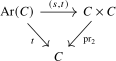
is a cocartesian functor over \(C\).
Proof. Recall from Example 23.1.10 that the target functor \(t\colon \Ar (C) \to C\) is a cocartesian fibration whose cocartesian morphisms are those squares inverted by \(s\colon \Ar (C) \to C\). The projection functor \(\pr _2\) is cocartesian by Lemma 23.1.13, and its cocartesian morphisms are those pairs \((g\colon X \to X', f\colon Y\to Y')\) such that \(g\) is an isomorphism. It follows immediately from these descriptions that \((s,t)\) is a cocartesian functor. □
Construction 23.4.2 (The Hom-functor). Let \(C\) be a small \(\infty \)-category. We construct a functor \(\Hom _C\colon C\catop \times C \to \An \).
By Lemma 23.4.1, the functor \((s,t)\colon \Ar (C) \to C \times C\) defines a morphism in \(\Cocart (C)\). Applying the cocartesian straightening functor, we thus obtain a morphism \[ \Str ^{\cc }(t) \to \Str ^{\cc }(\pr _2) \] in \(\Fun (C,\Cat _{\infty })\). Now, note that \(\pr _2\) is the pullback along \(p_C\colon C \to *\) of the map \(p_C\colon C \to *\), and it follows from the naturality of straightening that \(\Str ^{\cc }(\pr _2)\) is given by the composite \[ C \xrightarrow {p_C} * \xrightarrow {\Str (p_C)} \Cat _{\infty }. \] Since \(\Str (p_C)\) is simply the map picking out the object \(C \in \Cat _{\infty }\), this means that \(\Str ^{\cc }(\pr _2)\) is the constant functor \(\const _C \colon C \to \Cat _{\infty }\). In particular, the map \(\Str ^{\cc }(t) \to \Str ^{\cc }(\pr _2) \cong \const _C\) gives rise to an object \[ \Str ^{\cc }(t) \qin \Fun (C,\Cat _{\infty })_{/\const _C} \simeq \Fun (C,(\Cat _{\infty })_{/C}), \] i.e., we may treat it as a functor \(C \to (\Cat _{\infty })_{/C}\). We now claim that this functor factors through the full subcategory \(\RFib (C) \subseteq (\Cat _{\infty })_{/C}\). We may check this on objects: we have to show that for every object \(x \in C\), the functor \(\Str ^{\cc }(t)(x) \to \Str ^{\cc }(\pr _2)(x)\) is a right fibration. By naturality of \(\Str ^{\cc }(-)\), this evaluation is computed by forming the induced map on fibers over \(x\):
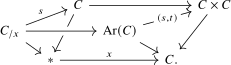
But this functor \(s\colon C_{/x} \to C\) is indeed a right fibration by Proposition 23.1.19. We thus obtain a functor \[ C \to \RFib (C) \xrightarrow [\sim ]{\Str ^{\ct }} \Fun (C\catop ,\An ). \] Uncurrying then gives the desired functor \(\Hom _C\colon C\catop \times C \to \An \).
Remark 23.4.3. There is an asymmetry in our definition of \(\Hom _C\): we could also have considered the cartesian functor
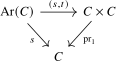
to get a functor \(C\catop \to \LFib (C) \simeq \Fun (C,\An )\). The resulting two functors can be shown to agree with each other: more generally, for bifibrations \(E \to C \times D\) the two ways of constructing a functor \(C\catop \times D \to \An \) agree, see [Haugseng et al. (2023), Proposition 6.18].
Generated from the authoritative LaTeX source.