Definition 12.3.3. Let \(\Oo \) be a colored operad. We define a symmetric monoidal category \(\Env (\Oo )\), called the envelope of \(\Oo \).
- The objects of \(\Env (\Oo )\) are unordered tuples \(\{x_i\}_{i \in I}\) of colors of \(\Oo \);
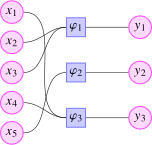
- A morphism \(\Phi \colon \{x_i\}_{i \in I} \to \{y_j\}_{j \in J}\) in \(\Env (\Oo )\) consists of a morphism of finite sets \(f\colon I \to J\) together with a multimorphism \(\phi _j \in \Oo (\{x_i\}_{i \in I_j};y_j)\) for
every \(j \in J\). Here we write \(I_j := f^{-1}(j)\) for the preimage of \(j\) under \(f\). We will visualize this data as follows:Here the function \(f\) is indicated by the lines from left to right, so that \(f(1) = f(4) = 3\), \(f(2) = f(3) = 1\) and \(f(5) = 2\).
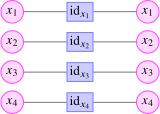
- The identity of \(\{x_i\}_{i \in I}\) is given by taking \(f = \id _I \colon I \to I\), and taking \(\phi _j = \id _{x_j} \in \Oo (\{x_i\}_{i \in \{j\}};x_j)\):
- The composition of \(\Phi = (f,\phi _j)\colon \{x_i\}_{i \in I} \to \{y_j\}_{j \in J}\) and \(\Psi = (g, \psi _k)\colon \{y_j\}_{j \in J} \to \{z_k\}_{k \in K}\) is given by \(\Psi \circ \Phi = (h, \xi _k)\) where \(h := g \circ f\colon I \to K\) is the composition of \(g\) and \(f\), and for every \(k \in K\) the multimorphism \(\xi _k \in \Oo (\{x_i\}_{i \in I_k};z_k)\) is the image of \((\psi _k, (\phi _j)_{j \in J_k})\) under the composition map \[ \circ \colon \Oo (\{y_j\}_{j \in J_k};z_k) \times \prod _{j \in J_k} \Oo (\{x_i\}_{i \in I_j}; y_j) \to \Oo (\{x_i\}_{i \in I_k};z_k); \] here we are implicitly using that \(I_k = (g \circ f)^{-1}(k) = f^{-1}(g^{-1}(k))\) may be written as the disjoint union of the sets \(I_j = f^{-1}(j)\) for \(j \in J_k = g^{-1}(k)\).
- The fact that composition in \(\Env (\Oo )\) is unital and associative precisely amounts to the unitality and associativity conditions for colored operads.
The category \(\Env (\Oo )\) admits a symmetric monoidal structure given by unordered concatenation of tuples.
Generated from the authoritative LaTeX source.